
Sell Florida Land for Townhome Development
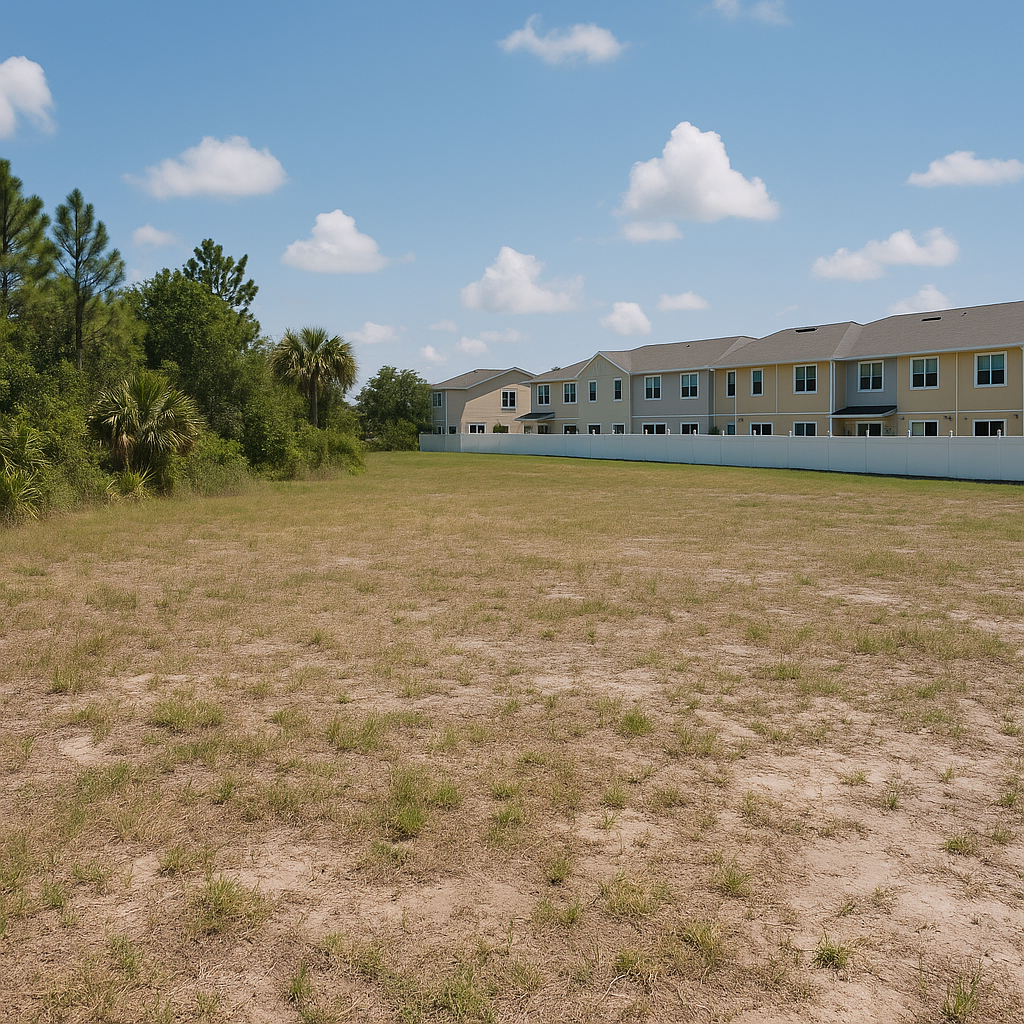
If you want to sell vacant land for townhome development in Florida, the important question is not simply whether the parcel is called residential. A townhome buyer needs to know whether a specific layout can work on the site—or which facts must be verified before anyone can answer that. For an absentee owner, the strongest position is to present the property as a documented opportunity, not as “townhome-ready” before the local review and site work support that conclusion.
Ultimate Land Deals publishes this guide for owners considering an off-market land sale. A prospective buyer may evaluate a parcel for direct purchase, assignment, or resale; the written offer should state the actual buyer, contingencies, assignment rights, and closing terms.
Treat townhome potential as a five-part site test
A townhome concept connects several separate issues. One favorable answer does not settle the others. Before discussing a developer price, organize the parcel around these five questions:
| Site question | What a seller can provide | What should remain a buyer or agency verification question |
|---|---|---|
| Density and use | Parcel identification, current zoning information you have, prior correspondence, and any recorded approvals | Is townhome development allowed, and what development pattern could be approved? |
| Access and frontage | Survey, legal description, recorded easements, photos, and the location of apparent road frontage | Does the parcel have the access and frontage needed for a proposed plan? |
| Utilities | Utility bills, existing account information, correspondence, maps supplied by a provider, and visible infrastructure photos | Can the proposed development be served, and on what terms? |
| Stormwater and drainage | Surveys, drainage records, plans, easement documents, and photos after rain if available | What stormwater and drainage measures would a proposed layout require? |
| Boundaries, title, and platting | Deed, prior title materials, surveys, legal description, and recorded documents | Does the contemplated layout require a plat or replat, and what must be submitted? |
This format is more useful than leading with acreage or an informal unit count. It tells a buyer where the work begins without turning an owner’s assumption into a representation.
Start with the layout, not a guessed unit count
Ask a prospective developer to describe the concept they are evaluating. A useful first description identifies the parcel, the intended townhome arrangement, anticipated entrances, internal circulation, parking concept, open areas, and the intended connection points for utilities.
Then ask one practical question: What prevents this concept from fitting today?
The answer may point to a width issue, an access issue, a utility question, drainage planning, or local development standards. Do not try to resolve that answer by estimating how many townhomes “should fit.” A rough count can be especially misleading when the buyer has not established the usable area, circulation needs, or local requirements.
Florida law requires local land-development regulations to implement the jurisdiction’s adopted comprehensive plan. Those regulations must address, among other matters, subdivision, land and water use, compatibility of adjacent uses and open space, flooding, drainage and stormwater management, and the availability of public facilities and services needed for development. Florida Statutes § 163.3202
That is why the city or county with jurisdiction over the parcel—not a neighboring project, a listing description, or a satellite image—should answer the project-specific questions.
Make frontage and access separate conversations
Owners often combine road frontage and legal access into one statement. Keep them separate.
A parcel may appear to touch a road on a map. That image does not by itself show what rights the parcel has, where the boundary lies, or how an entrance for a particular site plan would be evaluated. Provide the survey and recorded access documents you have. If you do not have them, say so plainly.
Ask the prospective buyer or local agency:
- Which road is proposed as the project entrance?
- Does the reviewer need a particular survey, plan, or access information to evaluate the concept?
- Are there recorded easements or other title matters that affect the proposed entrance location?
- Does the anticipated layout require additional land, a shared-access arrangement, or a change to the concept?
These questions do not assume a result. They expose whether a buyer is pricing a clearly defined tract or taking on a material access question.
Utilities are not established by nearby lines
For townhome development, a utility question is broader than whether utility infrastructure appears nearby. Keep the evidence limited to what you possess: provider correspondence, prior service records, maps provided by a utility, or photographs of visible facilities. Label each item by its source and date.
A buyer can then ask the relevant provider and local government whether the proposed project can be served and what information they need to review it. Avoid promising capacity, connection availability, or a particular improvement outcome unless the responsible party has provided a written, parcel-specific response.
The same discipline applies to drainage. Florida’s statutory framework requires local land-development regulations to regulate areas subject to seasonal and periodic flooding and to provide for drainage and stormwater management. Florida Statutes § 163.3202 That supports asking a precise question: what stormwater information does this jurisdiction require to review this particular concept? It does not support telling a buyer that an undeveloped parcel has no stormwater issue.
Know when a plat conversation has begun
Do not assume that every townhome concept requires the same land-division process. Instead, ask the local planning or development-review office whether the contemplated proposal involves a plat or replat and what the agency needs to make that determination.
If a plat or replat is submitted to a local approving agency, Florida law says it must be accompanied by a boundary survey of the platted lands and a Florida attorney’s title opinion or a property information report showing record title in the name of the entity executing the dedication, along with unsatisfied or unreleased mortgages shown in the report or opinion. Florida Statutes § 177.041
The statute also provides for administrative approval of a plat or replat that complies with the referenced statutory requirements, through an authority designated by the county or municipality. Florida Statutes § 177.071 Whether that provision applies to a given proposal is a local, project-specific question—not a selling claim.
For a seller, the immediate task is simpler: locate the current survey, deed, legal description, prior title materials, and any prior plat documents. Those materials help a buyer decide what additional work is needed.
Package facts, not conclusions
A concise townhome-development file can include:
- Parcel ID, street address if one is assigned, county, and municipality if applicable.
- Current deed and legal description.
- Most recent survey, with the date visible.
- Recorded easements, restrictions, or other documents in the owner’s files.
- Existing zoning or land-use correspondence, clearly dated and sourced.
- Utility and drainage records actually received by the owner.
- Photos showing road frontage, apparent access points, terrain, drainage features, and visible utility infrastructure.
- A one-page list of unanswered questions for the buyer to verify.
The unanswered-question list is not a weakness. It prevents a buyer from mistaking an owner’s observations for engineering, title, utility, or local-government confirmation.
Choose a sale route based on who will carry the unanswered work
A direct land buyer can be a sensible route when you want one party to evaluate the development questions and make an offer that reflects its own diligence. Read the contract closely: identify the buyer, determine whether assignment is permitted, and understand the conditions that affect closing.
A land-focused agent can help expose the parcel to developers, but ask how the property will be described and whether the marketing avoids unsupported townhome claims. An independent sale gives the owner control over outreach and documents, while leaving the owner responsible for managing inquiries and keeping statements consistent.
The best route depends less on a generic promise of a higher price than on the seller’s willingness to wait through development diligence, share records, and accept the contract terms offered.
Resources
- Florida Statutes § 163.3202: Land development regulations
- Florida Statutes § 177.041: Survey and title materials for submitted plats or replats
- Florida Statutes § 177.071: Administrative approval of qualifying plats or replats
FAQs
Should I advertise my lot as suitable for townhomes?
Only describe what you can support with records. A safer approach is to identify the parcel and its available documents, then say that a buyer should verify its proposed townhome concept with the responsible local agencies and providers.
Do I need a new survey before asking for offers?
Not necessarily. Start by providing the survey you have and its date. A buyer can determine whether the concept and any proposed submission require updated survey work.
Can I accept an offer before every development question is resolved?
You can evaluate offers while questions remain, but the agreement should clearly state the buyer, any due-diligence conditions, assignment rights, and the terms that govern closing. Do not rely on informal statements about what the parcel will support.
What is the most useful first call to the local government?
Give the parcel identification and a short written description of the proposed townhome concept. Ask which department reviews that type of proposal and what parcel-specific materials it needs to address use, access, utilities, stormwater, and any plat or replat question.