
Palm Coast Land Assemblage: When Adjacent Lots Matter
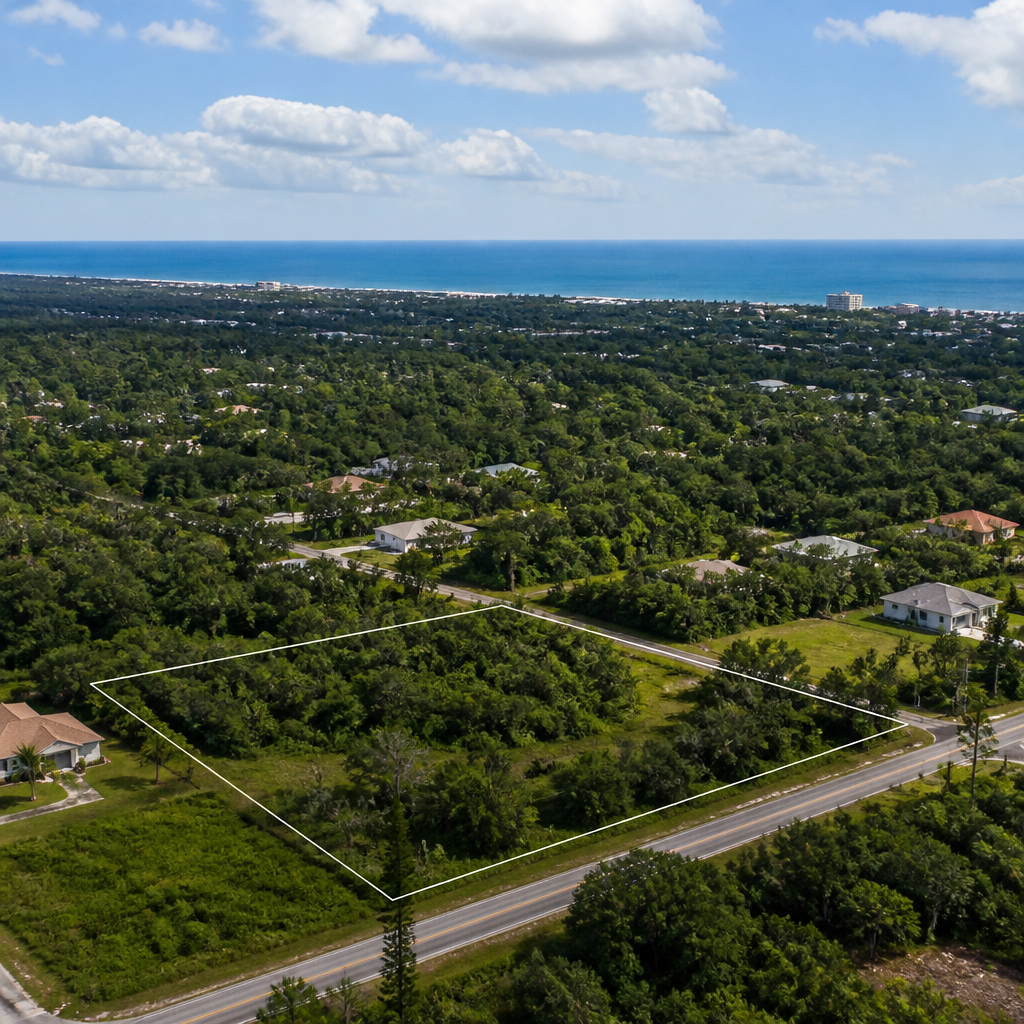
A Palm Coast land assemblage becomes more compelling when putting parcels together solves a real development problem: it creates usable access, a more workable building area, a better site shape, or enough coordinated land for a buyer’s stated plan. Simply owning two lots beside one another is not, by itself, proof of a stronger builder opportunity.
Ultimate Land Deals publishes this guide for Palm Coast-area vacant-land owners who have been approached about neighboring lots or are considering whether to sell several parcels together. The useful question is not “How many acres or lots are involved?” It is: what can the combined site accomplish that the individual parcels cannot?
Start with the map—but do not stop there
Lay out every relevant parcel on one working map: your land, the adjoining lots, any strips between them, and the roads that appear to serve the area. Then mark who owns each parcel. An assemblage only exists when the land can be controlled together; a visual block of adjacent lots under unrelated ownership is an opportunity to investigate, not a finished site.
For each parcel, make a short ownership-and-boundary worksheet:
| Question | Why it changes the opportunity |
|---|---|
| Who is shown as the current owner? | A potential buyer needs to know which owners would need to agree to a sale. |
| Do the parcels touch at a meaningful boundary? | Corner contact may not create the same usable layout as a shared side boundary. |
| Is there a gap, separately owned strip, or roadway between them? | What looks contiguous on a broad map may not be land that can be combined or used together. |
| Which parcel appears to meet a public road? | A buyer should independently confirm the nature and adequacy of access. |
| Are there separate legal descriptions or recorded documents to review? | A combined marketing story should not substitute for the actual parcel records. |
Do not describe several parcels as “one development site” before a buyer, title professional, and appropriate public offices have reviewed what would be necessary to carry out the proposed plan. The strongest early description is factual: parcel identifiers, apparent adjacency, known ownership, and the questions still open.
Look for a specific constraint the combination could solve
A builder or developer does not necessarily value adjacency for its own sake. They may be testing whether additional land changes the site’s practical envelope—the portion of land left after the project’s physical and approval-related constraints are considered.
That makes these four comparisons more useful than a blanket claim that a combined tract is “better.”
1. One lot has road presence; another adds depth or width
A parcel facing a road may be important, while the adjacent parcel provides room behind or beside it. That pattern can be worth discussing with a buyer, but it raises precise questions: Which parcel is proposed for entry? Is the connection actually available for the buyer’s intended use? Does the proposed layout depend on land not controlled by the seller?
Avoid treating a road drawn on a map, or a nearby road, as confirmation of legal or functional access. Ask the responsible agency or the buyer to identify the access assumption in writing.
2. Each lot is awkward alone, but the outside boundary is more useful together
Narrow, shallow, irregular, or corner parcels can sometimes form a more coherent outside shape when assembled. Here, a sketch is more revealing than a combined acreage figure. Ask a prospective buyer to show a conceptual footprint—not as an approval, but as a way to identify the exact issue they believe the assemblage resolves.
A buyer who cannot explain the site advantage may simply be seeking a larger negotiating position, not a uniquely useful tract.
3. A proposed project needs coordinated land rather than scattered lots
Several lots may interest one buyer because the buyer wants control over the same block or a connected portion of it. The owner should ask whether every parcel is essential, preferred, or merely optional. That distinction affects negotiating leverage and whether selling one parcel could reduce the value of another.
4. The combined site may still have a constrained buildable area
More land does not automatically mean more usable land. Before relying on an assemblage premium, ask what conditions could reduce or reshape the development envelope. The relevant questions are site-specific:
- What land area does the buyer expect to use for buildings, circulation, drainage, open space, or other project elements?
- What mapped conditions, recorded restrictions, or other documents does the buyer want reviewed?
- Does the concept depend on approvals, changes, or third-party agreements?
- Which assumptions are central enough to be written into the offer or its contingencies?
Palm Coast’s Community Development Department includes Planning, Building, and Code Enforcement, and the City says the department provides guidance for well-planned growth while regulating development for natural resources, public health, safety, and welfare. That makes it a relevant place to direct parcel-specific planning questions rather than relying on a buyer’s generalized description of potential. Palm Coast Community Development
Test the buyer’s assemblage story before pricing your land around it
Owners sometimes receive an offer that implies their parcel is the “last piece.” That may be true, but it deserves a calm, document-based follow-up. Ask the buyer:
- Which other parcel numbers are part of the proposed assemblage?
- Which owners have already agreed, if any? A buyer can answer without disclosing confidential pricing.
- What specific site problem does my parcel solve? Ask for a plain-language explanation and, if available, a concept sketch.
- Is the offer dependent on acquiring other land, planning review, access, or another event?
- What happens if those events do not occur? The written agreement, not the verbal development narrative, should govern your decision.
- Does the buyer plan to purchase, assign, or otherwise transfer its contract rights? If that matters to you, ask for the contractual language and consider professional advice before signing.
These questions do not require an owner to become a planner. They keep the negotiation tied to the actual reason the parcel is being pursued.
Separate current planning information from old headlines or proposals
Palm Coast’s page for the Future Planning Area West of U.S. 1 states that the Westward Expansion project is no longer under City consideration after the applicant withdrew its requests on August 21, 2026. The page describes the proposed area as approximately 20,144 acres west of U.S. 1, but it is not evidence that an individual parcel has an active project path or a particular future value. Future Planning Area West of U.S. 1
That distinction matters in an assemblage conversation. A buyer may refer to broad growth concepts, proposed projects, or nearby activity. Ask what is current, which map or application supports the claim, and whether it applies to your exact parcel. Do not price a sale on the assumption that an old proposal remains active.
If you need documents from Flagler County, begin with the County’s Public Records Request page and state the parcel identifiers and records sought as clearly as possible. A targeted request is more useful than asking generally whether the area is “developable.”
Choose the sale route based on the complexity of the assemblage
An assemblage can call for a different selling approach than a standalone lot.
A direct buyer can be a practical option when the buyer can explain the parcel’s role and puts price, contingencies, closing terms, and any assignment rights in a written agreement. The tradeoff is that the buyer may be evaluating the land for a narrow use, so the offer can be shaped by conditions outside your parcel.
An agent experienced with land may be useful when several builders or developers could plausibly value the same assembled position, or when you want broader exposure. Ask how the listing will identify the assemblage opportunity without overstating approvals or site capacity.
Selling independently gives an owner control over outreach and timing, but it also requires keeping parcel information, maps, and buyer questions organized. It can work when the ownership picture is simple and the owner is prepared to compare written proposals carefully.
No route eliminates the need to read the agreement. Compare the expected proceeds, the events that can delay or end the transaction, who is responsible for obtaining information, and what happens if neighboring acquisitions do not materialize.
A disciplined next step for adjoining owners
If you and a neighbor are considering a coordinated sale, do not assume identical goals. One owner may need certainty; another may prefer to wait; a third may not wish to sell at all. Each owner should obtain independent advice appropriate to their situation before agreeing to joint pricing, marketing, or contract terms.
The practical first move is modest: build the parcel map, identify the ownership gaps, and ask a prospective buyer to explain the precise advantage created by your land. A credible Palm Coast land assemblage opportunity becomes clearer at that point—through the relationship between parcels, access, the proposed envelope, and written deal terms, not through a larger-looking outline on a map.
Resources
- Palm Coast Community Development
- Flagler County Public Records Request
- Palm Coast Future Planning Area West of U.S. 1
FAQs
Does owning adjacent parcels guarantee a higher offer?
No. The key question is whether the combined parcels solve a specific problem for a buyer’s stated plan. Ownership gaps, access questions, an irregular site shape, or a limited development envelope can all affect the opportunity.
Should I sell my lot before knowing whether neighbors will sell?
Ask the buyer whether neighboring acquisitions are essential to its offer and have that answer reflected in the written terms where appropriate. Selling first can be reasonable in some circumstances, but an owner should understand whether the buyer’s price or obligation depends on land it does not yet control.
Can a buyer call my parcel the final piece of an assemblage?
A buyer can make that claim, but you should ask which parcels are involved, what role yours plays, and whether other owners have agreed. A map and a written explanation are more useful than a label.
Who can answer site-specific planning questions in Palm Coast?
Palm Coast identifies Planning as part of its Community Development Department. Direct parcel-specific planning questions to the appropriate City office, and keep any response with your parcel file. Palm Coast Community Development