Palm Coast Infill Lots: What Builders Underwrite First
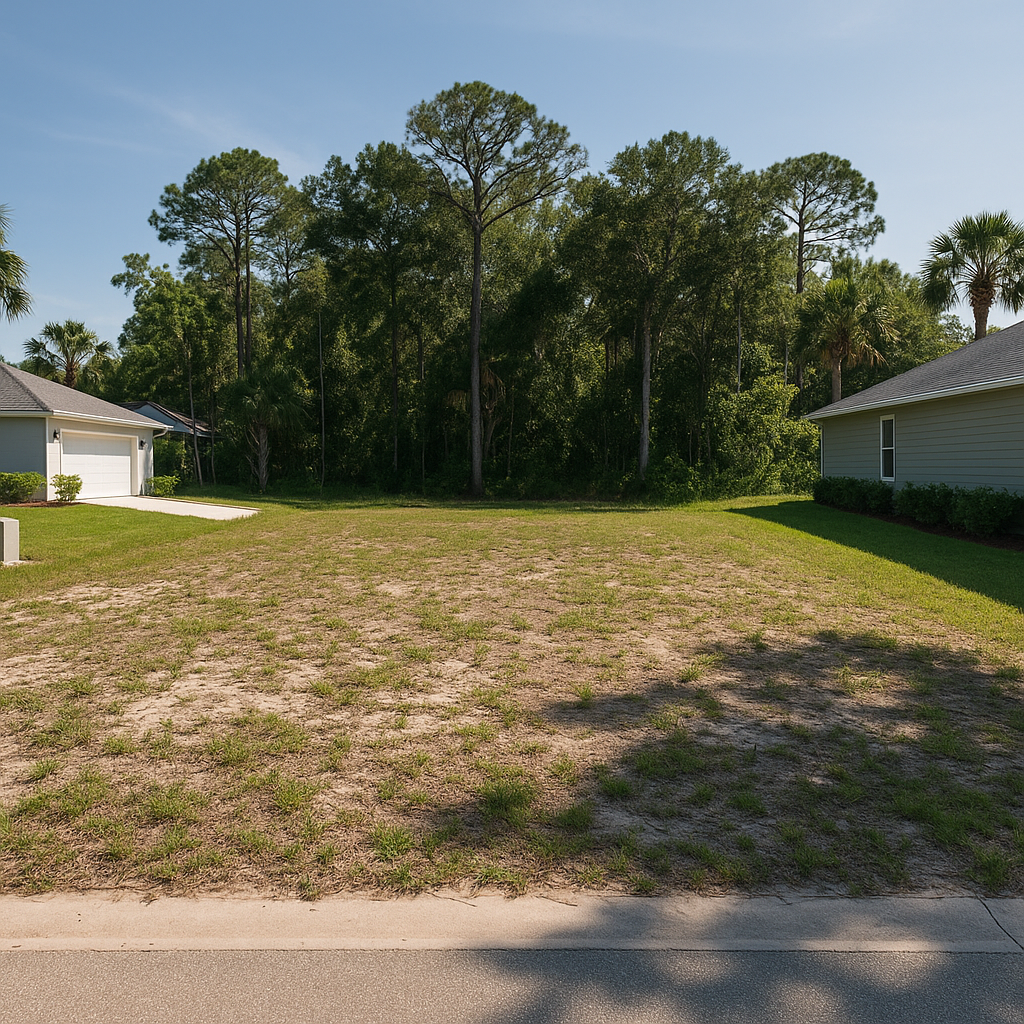
A Palm Coast infill lot is attractive to a builder when it can move from acquisition to a permitted, financeable home with fewer unknowns than the alternatives. The lot does not need to be perfect. It does need to fit a builder’s product, budget, and construction schedule.
For an absentee owner, that changes the practical question behind Palm Coast infill lots for builders. The question is not simply, “What are lots selling for nearby?” It is: which facts would let a builder underwrite this particular parcel without spending weeks chasing basic answers?
The following illustrative case study shows how a builder may separate a viable production lot from a parcel that looks similar on a map but receives a lower offer—or no offer at all.
Case study: two platted lots, two very different acquisition decisions
Assume an owner has a vacant residential lot in Palm Coast and is considering an off-market sale. The parcel is in an established neighborhood with paved streets and completed homes nearby. A second vacant lot, a few blocks away, has a similar recorded size and appears to have the same general residential use.
On a broad comparable-sales search, the two parcels may look interchangeable. A builder usually does not treat them that way.
Lot A: the “production-ready” candidate
A builder reviewing Lot A learns the following early:
- The parcel is within the City of Palm Coast rather than an unincorporated area with a different approval path.
- Its zoning and dimensional requirements appear compatible with the builder’s standard house plan, subject to formal confirmation.
- The lot has public road frontage and no obvious access issue.
- Water and sewer service information can be verified with the relevant utility provider or city department; the owner has not represented mere nearby lines as confirmed service.
- The site is not obviously constrained by a drainage feature, easement, unusual shape, or flood-related condition that would require redesign.
- Nearby newer homes support the builder’s intended finished-home price range.
- The seller can provide the parcel number, legal description, tax status, and any prior survey, site information, or correspondence already in hand.
That is not the same as a guaranteed build. The builder still performs its own due diligence. But Lot A gives the buyer a reasonably direct path to answer the underwriting questions that matter.
Lot B: the “looks good online” candidate
Lot B has a similar lot size and similar surrounding homes. But the initial review raises unresolved questions:
- The parcel’s jurisdiction and utility provider are unclear.
- An old listing says “utilities available,” but no one has confirmed service location, connection requirements, or whether extensions are needed.
- The lot’s dimensions may force a narrower plan or a redesign after setbacks are applied.
- A drainage swale, easement, or physical condition may reduce the usable building area.
- The buyer cannot tell from the available information whether the neighborhood supports the same finished-home pricing as Lot A.
A builder can still buy Lot B. It may simply protect itself with a lower price, a longer inspection period, or a contract contingent on findings that Lot A allowed it to verify quickly.
The difference is not that Lot A is “good” and Lot B is “bad.” The difference is development friction. Builders price friction because it can consume time, require a different house plan, add site costs, or cause a parcel to sit while other lots are being built.
What a Palm Coast builder is actually underwriting
A builder buying one infill lot is making a smaller version of a development decision. The land cost is only one part of the model. The buyer is also estimating the cost and risk of turning the parcel into a completed home.
A useful simplified equation is:
Expected finished-home value
minus construction cost, land cost, utility and site work, permits and fees, financing and carrying cost, selling cost, contingency, and required profit
equals the maximum the builder can justify paying for the lot.
This is why a recent vacant-lot sale is useful but incomplete. The comparable may have had a different utility situation, a more usable footprint, a different street character, or a buyer with a different home product.
For Palm Coast infill lots, the main underwriting screens tend to be these.
1. Can the builder put its house on the site?
Builders commonly prefer lots that accept plans they already know how to build. A parcel may be residential in concept yet still be awkward for a builder’s standard product because of width, depth, setbacks, corner-lot conditions, easements, drainage features, or required orientation.
An owner does not need to commission a full design before seeking offers. It is helpful, however, to provide accurate dimensions, a survey if one exists, and any information that reveals a restriction on the buildable area.
A narrow or irregular lot is not automatically less valuable. It may be well suited to a builder that specializes in narrower homes. It is less likely to fit every buyer’s acquisition box.
2. Is there a practical utility path?
“Utilities” should be broken into specifics. A builder needs to know which provider serves the area, whether water and sewer are available to the parcel or nearby, and what connection or extension work may be required. Electric service is a separate inquiry.
Do not assume that homes on the street answer every question. Service can differ by side of the road, segment of the street, prior extension history, or current capacity and connection requirements.
For a seller, the productive approach is to state only what can be supported: the provider believed to serve the area, the location of visible infrastructure if known, and any written confirmation already received. Let the buyer verify the rest.
3. Does the street support the intended finished-home price?
A builder is buying future resale potential, not just dirt. Recent new construction, home condition, neighborhood pattern, traffic exposure, and competing inventory can all affect what the finished house can sell for.
This is where a corner lot can go either way. It may offer extra visibility, access flexibility, or a more open feel. It can also carry additional setback or design considerations. Builders will evaluate the specific location, not the label “corner lot.”
4. Can the buyer acquire it on a usable timetable?
A builder with active crews and existing home plans often values a straightforward lot more than a speculative buyer does. A clear ownership record, available parcel documents, and a seller who can respond to due-diligence questions help the transaction move.
That does not mean an owner should accept the first offer labeled “builder cash.” It means the buyer most likely to pay for the lot’s real development utility needs enough information to recognize it.
The seller’s builder packet: enough information, not a sales brochure
An absentee owner can make an off-market lot easier to evaluate by assembling a concise digital file. This is especially useful when the owner is not local and cannot meet a buyer at the parcel.
Include:
- Parcel identification: address if assigned, parcel number, legal description, and a county property-appraiser link or record.
- Aerial and location context: a current aerial image plus photos of the frontage, street, and nearby construction if available.
- Lot geometry: a survey, plat excerpt, or recorded dimensions. Identify any known easements shown on documents.
- Known site information: prior environmental, soil, drainage, wetlands, utility, or permitting material—if it exists. Do not create conclusions from old documents.
- Basic transaction facts: current tax status, how title is held, and the seller’s preferred closing window.
The packet should not claim that the lot is buildable, utility-ready, or permit-ready unless a current authority has confirmed that specific point. Builders expect to verify. What they value is a seller or land source who does not blur facts, assumptions, and marketing language.
When a single lot is worth more as part of a small assemblage
A lone Palm Coast infill lot can fit a local builder, custom-home operator, or investor. But its value may change if an adjacent owner is also willing to sell.
A two- or three-lot assemblage can create room for a broader house plan, multiple starts on one street, shared mobilization efficiency, or a cleaner small development concept. It can also introduce complications if the lots have different owners, title conditions, utility situations, or pricing expectations.
An owner should not hold a sellable lot indefinitely waiting for neighbors to participate. The better question is whether adjacency changes the buyer pool enough to justify a coordinated conversation. If it does, each owner still needs separate advice on price and contract terms; an assemblage is not automatically more valuable in every location.
How Ultimate Land Deals approaches builder-oriented lots
Ultimate Land Deals evaluates vacant parcels for direct purchase, resale, or assignment based on the property and the likely buyer fit. For Palm Coast infill opportunities, that may mean determining whether a lot belongs with a builder seeking a specific residential site rather than treating it as generic vacant land.
For an owner, the useful first step is a fact-based review of the parcel: location, lot configuration, apparent development path, available records, and the level of demand from buyers who actually acquire residential lots. If the parcel fits a builder’s criteria, an off-market transaction can avoid the delay of broad listing exposure while still giving the buyer room for normal due diligence.
The strongest Palm Coast infill lot is not necessarily the largest lot or the lot with the highest online estimate. It is the one a qualified buyer can understand, price, and turn into a finished home with a manageable amount of uncertainty.