
Palm Bay Residential Lot Assemblage Opportunities
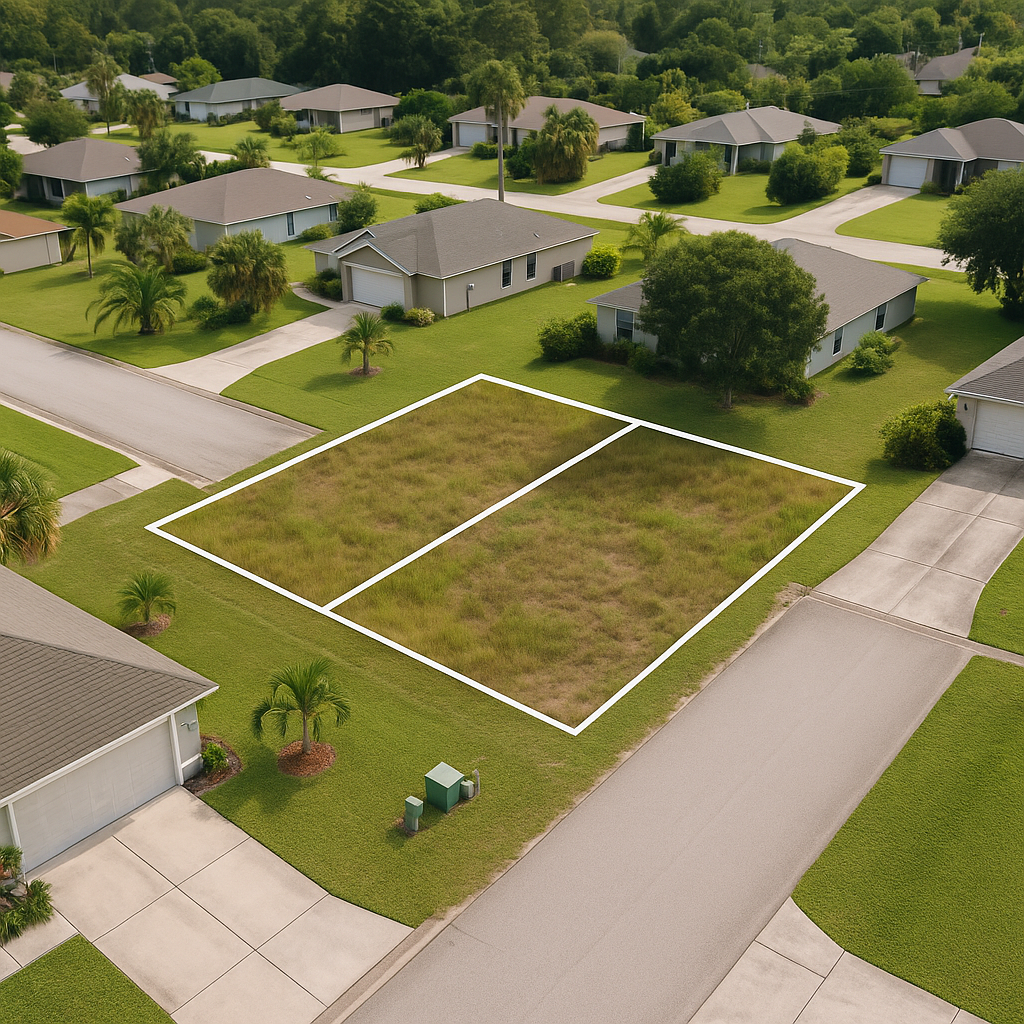
A group of adjoining Palm Bay lots can be more attractive to a builder or developer than the same parcels sold one at a time—but only if the group can be controlled, reached, and reviewed as one coherent acquisition. For an absentee owner, the central question is not simply whether your lot touches another vacant parcel. It is whether your parcel helps solve a specific gap in a potential residential site.
Ultimate Land Deals publishes this guide for owners considering Palm Bay residential lot assemblage opportunities. Its published Florida land-buying information describes a direct-to-owner process for vacant land and states that the company may buy, assign, or resell a parcel depending on the opportunity. Any proposed price, closing terms, inspection period, and assignment rights should still be confirmed in the written agreement. Ultimate Land Deals’ Florida cash-offer overview
Assemblage value comes from the missing piece—not the lot count
An assemblage is a collection of separately owned parcels pursued together. A two- or three-lot group is not automatically a development opportunity. The useful question is more precise:
Does combining these particular parcels create a site that a buyer could reasonably evaluate for a residential concept that none of the parcels supports as well alone?
One parcel may supply street frontage. Another may fill an irregular interior gap. A corner lot may affect how a larger tract meets two roads. Conversely, an owner’s lot may be adjacent on an aerial image but add little if it is separated by a right-of-way, has a different ownership history, or does not improve the larger site’s shape.
This distinction matters in negotiations. A buyer who needs every parcel in a block faces a different acquisition problem from a buyer who has several workable site layouts and can proceed without one owner. Do not assume a neighboring owner’s asking price, tax assessment, or enthusiasm establishes the value of your parcel within an assemblage.
Four screens a serious buyer will use
Before treating an adjacent-lot opportunity as actionable, organize the facts around four screens. They are not approvals or conclusions about what can be built; they are the questions that determine whether further review is worth the effort.
1. Contiguity and site shape
Start with a simple parcel map showing the subject lot, each touching parcel, roads, apparent corners, and any gaps. Label each parcel by its parcel identifier rather than an informal street description.
Ask:
- Do the parcels actually share boundaries, or only appear close on a map?
- Which parcels create usable width, depth, frontage, or a more regular outline?
- Is there a parcel in the middle of the proposed group that cannot be avoided?
- Are roads, drainage features, recorded corridors, or other visible conditions interrupting the apparent assemblage?
A rough visual map is useful for identifying candidates. It is not a substitute for title, survey, or jurisdictional review.
2. Ownership fragmentation
The hardest parcel to acquire is often not the largest one. It may be a small lot owned by multiple people, an estate, a trust, a company, or an owner whose mailing address is outdated. Fragmentation changes both timing and leverage.
Create an owner matrix before making assumptions about the opportunity:
| Parcel | Recorded owner name(s) | Mailing address on available records | Role in the site concept | Contact or title question |
|---|---|---|---|---|
| Your parcel | Frontage / depth / corner / fill-in | |||
| Adjacent parcel A | ||||
| Adjacent parcel B | ||||
| Interior or key parcel |
For a remote owner, this exercise helps separate a genuine coordinated opportunity from a loose cluster of lots with no realistic path to common control. Do not represent that every owner is willing to sell merely because their property appears vacant or because mail was delivered successfully.
3. Access and physical connection
A buyer needs to understand how the combined property relates to a public road or another lawful route. In an assemblage, access should be examined at the group level and parcel level. A lot that appears to have road frontage can still raise title, boundary, or layout questions that require professional review.
Prepare questions rather than conclusions:
- What documents identify the parcel boundaries and road relationship?
- Is the planned entry point on a parcel the buyer expects to control?
- Would leaving out one owner’s lot change the apparent route, site shape, or project concept?
- What title, survey, engineering, or City review would a buyer want before relying on the proposed layout?
Do not describe utility service, legal access, or a development entrance as confirmed based only on proximity to a road or visible nearby infrastructure.
4. Planning consistency and review path
A buyer will generally want to know whether the properties are governed by compatible planning information before spending substantial time on negotiation. That does not mean an owner should promise that a proposed project is permitted.
Palm Bay’s Land Development division maintains the City’s Comprehensive Plan and Land Development Code, performs administrative review of site plans, and provides related planning functions. City of Palm Bay Land Development The City also identifies its iMS portal as the submission point for Land Development applications. Its forms page says certain public-hearing applications go before the Planning and Zoning Board and/or City Council, and that complete, accurately labeled submissions help processing. Palm Bay Forms & Guidelines
For an owner, the practical takeaway is narrow: request or preserve the information a buyer needs to ask informed questions. Do not infer that the same district label, nearby homes, or a vacant-lot pattern answers the question for a combined tract.
The one-page package that makes an owner easier to evaluate
An absentee owner does not need to assemble a full development application to explore a sale. A compact, candid package is usually more useful than a long list of unsupported claims. Include:
- Parcel identifier and property address, if one is used in available records.
- A map marking the parcel and potential neighboring parcels.
- The deed or other ownership document available to you.
- Known title, estate, lien, boundary, or code correspondence, if any.
- The planning information you have, identified by source and date rather than described as a buildability determination.
- A short note stating what is unknown: neighboring owners’ willingness, survey status, access documentation, utility questions, and any City review still needed.
This package allows a prospective buyer to decide whether to make an offer, seek more information, or decline without relying on an owner’s verbal characterization of the site.
How an owner can assess an assemblage offer
An offer tied to neighboring lots deserves a closer read than an offer for a stand-alone parcel. Compare the commercial terms, not just the stated purchase price.
| Question | Why it matters |
|---|---|
| Is the buyer obligated to buy your parcel alone, or only if other parcels are acquired? | The answer affects the certainty of the proposed sale. |
| Is there an inspection or due-diligence period? | It identifies when the buyer can review title, planning, and site issues. |
| Does the contract allow assignment? | Assignment rights affect who may ultimately take the buyer’s contractual position. |
| What documents or cooperation does the buyer request? | This clarifies the owner’s role before closing. |
| Who is coordinating title and closing? | The parties should be identified in writing. |
| What conditions could prevent closing? | Conditions may be more important than the headline price. |
A direct buyer can be appropriate when an owner values a single point of contact and a written offer for the existing parcel. An agent may be useful when the owner wants broad marketing and believes multiple buyers may value the location differently. Selling independently can preserve owner control over outreach, but the owner must handle buyer screening, records, negotiation, and transaction coordination. The best route depends on the written terms and the work each route leaves with the seller.
Palm Bay’s Building Department provides online permit resources and states that its Digital Plan Room supports electronic submission, review, approval, and document access for available permit applications. Palm Bay Building Permits & Inspections That is relevant to a buyer’s later project process, not evidence that any particular assemblage will receive approval.
Questions to send before engaging neighboring owners
- Which parcels are essential to the concept, and which are optional?
- What is the proposed acquisition sequence?
- Is the buyer evaluating an existing parcel group, or asking owners to help create one?
- What planning, title, survey, access, or utility questions remain open?
- Will the buyer make an offer for my parcel even if a neighboring owner declines?
- What exactly must happen before the buyer is required to close?
Clear answers protect an owner from overstating the opportunity while making a workable site easier for a serious buyer to evaluate.
Resources
- City of Palm Bay Land Development
- City of Palm Bay Forms & Guidelines
- City of Palm Bay Building Permits & Inspections
FAQs
Does my Palm Bay lot need to be large to matter in an assemblage?
Not necessarily. Its relevance depends on what it contributes to a larger tract—such as frontage, depth, a corner, or a missing connection between parcels. A buyer must determine whether that contribution supports a viable site concept.
Should I contact every adjoining owner before asking for an offer?
Not always. First identify whether your parcel is likely essential or optional and ask a prospective buyer how it views the group. Broad outreach can be useful, but it can also create confusion if no defined acquisition plan exists.
Can I state that several adjacent lots are ready for development?
Only if you have support for that specific statement. A more accurate description is that the lots are adjacent and may warrant buyer, title, survey, planning, and other appropriate review.
What should I do if a buyer wants to tie up my lot while pursuing neighbors?
Read the contract carefully and identify the purchase price, duration, contingencies, extension rights, assignment language, closing party, and the conditions under which the buyer can terminate. Consider obtaining legal advice on the agreement before signing.