
Pahrump Buildable Lots With Water and Power: Verify First
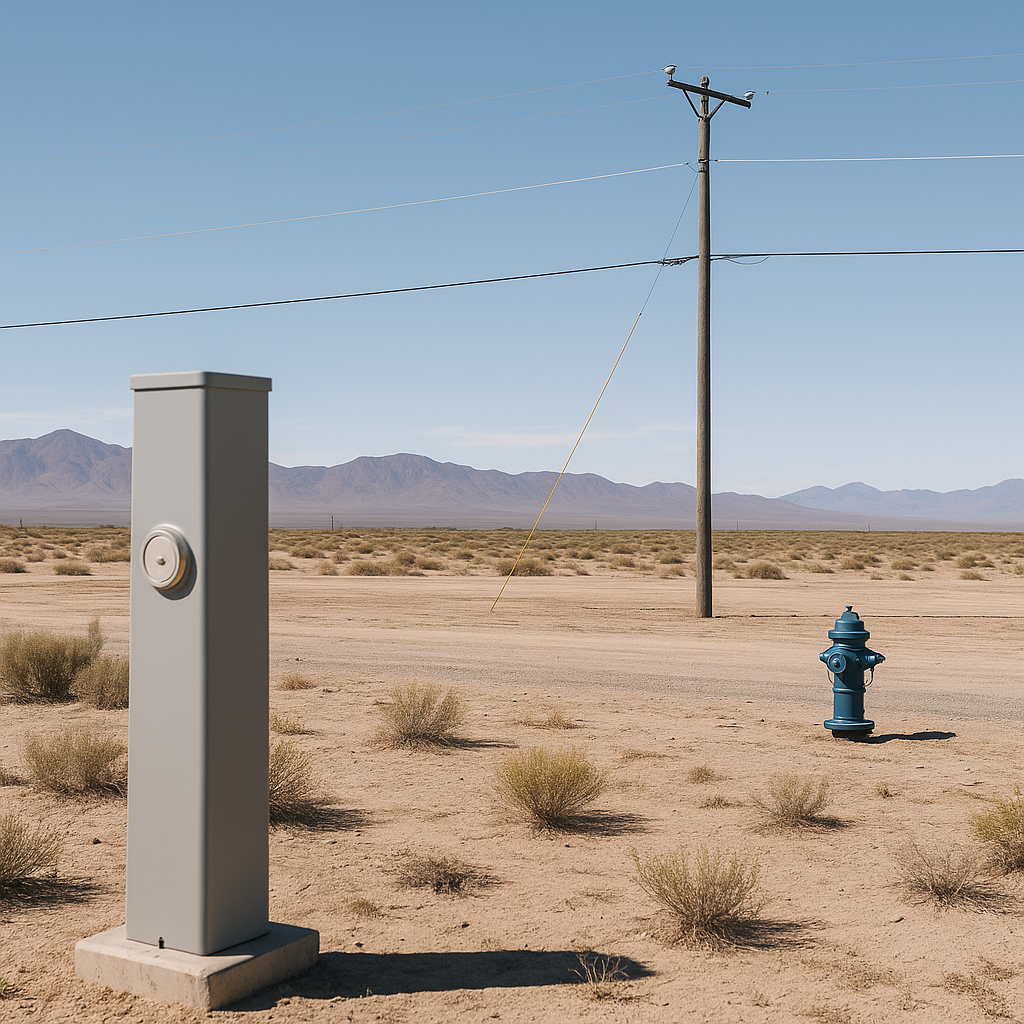
A Pahrump lot can have water and power nearby without being ready for a house—or priced like one. Before making an offer, separate three very different situations:
- Utilities are in the street or general area.
- The parcel can be connected, subject to provider review, extension costs, and permits.
- The parcel already has a water service and electric service in place.
For a builder, investor, or buyer planning a home, only the third situation deserves to be described as close to shovel-ready. The second may still be a good acquisition, but its price needs to leave room for uncertainty and installation cost.
This is the practical screen to use when evaluating Pahrump buildable lots with water and power, particularly when the parcel is being marketed remotely or the seller has not visited it in years.
Start with the right question: what is actually at the property line?
Listings often use broad utility language: “power nearby,” “water available,” or “utilities in the area.” Those phrases are not useless, but they do not answer the question that controls cost and schedule:
Is there an existing, usable service point for this specific APN, and what must happen before a meter can be installed?
For electric service, the answer may involve a distribution line along the frontage, a pole location, transformer capacity, easements, line-extension rules, and the location of the planned home. In the Pahrump area, electric-service questions should be confirmed directly with the serving utility, often Valley Electric Association, rather than inferred from aerial imagery or a neighboring meter.
For water, the key issue is whether the parcel is inside a public or private utility service area with a connection available—or whether the intended water source is a private well. Much of greater Pahrump relies on individual wells and septic systems. A water main in a nearby subdivision does not mean every parcel can tap into it, and a nearby house with a well says little about the cost or yield of a well on your lot.
A claim-by-claim utility audit
Use the seller’s APN and street address, if assigned, to create a short verification file. Do this before treating a lot as comparable to an improved homesite.
1. Verify the electric-service condition
Ask the utility provider for information tied to the actual parcel, not merely the road name. Useful questions include:
- Is electric distribution available at the parcel frontage?
- Is there an existing service drop, meter pedestal, or prior service account associated with the APN?
- Will the proposed service require line extension, a new transformer, or an easement?
- What documents, site plan, load information, or permits are required for a service estimate?
- Are there construction deposits, engineering charges, or timing considerations before permanent service can be installed?
A visible pole across the road is encouraging, not conclusive. Crossing a roadway, extending a line, or serving a large custom home can change the scope. Do not rely on an informal statement that “the neighbor has power.”
2. Determine which water model applies
There are two very different value propositions:
Utility water: Confirm the provider, service-area status, main location, capacity, connection process, meter or impact fees, and whether a lateral already serves the parcel. If a water company indicates service is possible, ask for the answer in writing and find out what work remains the buyer’s responsibility.
Private well: Treat the lot as a well-and-septic site, not as a utility-water lot. Review nearby well information where available, but understand that nearby results are not a guarantee of depth, production, water quality, drilling cost, or approval on your parcel. A local well driller can provide a preliminary opinion, but only a properly completed well process establishes what your site will produce.
For an acquisition, the distinction matters because “water available by well” is not equivalent to “water meter installed.” The end buyer, lender, and builder may value those conditions very differently.
3. Do not leave wastewater out of the buildability test
Water and power may be the headline, but wastewater can still stop a build. Many Pahrump parcels will need an individual septic system. That calls for a site-specific evaluation rather than an assumption based on nearby construction.
Before paying a finished-lot price, confirm with Nye County or the appropriate permitting authority what is required for septic review and whether known conditions could make a conventional system difficult or expensive. Setbacks, lot dimensions, soil conditions, and the planned well location can all affect the usable building envelope.
A parcel with electric frontage, an existing water meter, and no feasible septic area is not a conventional buildable lot.
The four lot categories buyers should price differently
Rather than sorting Pahrump land into “utilities” and “no utilities,” use these categories.
| Category | Typical condition | Buyer implication |
|---|---|---|
| Finished or near-finished homesite | Existing meter/service points, known access, and a workable path for wastewater | May justify a premium if zoning and site conditions align |
| Utility-adjacent lot | Power and/or water facilities are close, but connection work remains | Value depends on written estimates and extension risk |
| Well-and-septic build site | Electric may be nearby; water and wastewater require private systems | Can suit custom-home buyers, but needs adequate cost allowance |
| Speculative rural parcel | Utility claims are distant, unclear, or dependent on major improvements | Should not be valued as a near-term building lot |
The biggest pricing mistake is comparing a utility-adjacent parcel to a finished homesite because both are described as having “water and power.” A seller may use those words in good faith, especially if they bought the property years ago, but the buyer still needs to underwrite the difference.
Buildability is more than utilities
A lot with confirmed service is not automatically buildable for your intended project. Before finalizing an offer, check these items alongside the utility file:
- Zoning and minimum lot requirements: Confirm the current zoning, permitted residential use, density, setbacks, and any overlay restrictions with Nye County.
- Legal and physical access: A graded road visible on a map is not necessarily recorded legal access or a road that construction crews can reliably use.
- Parcel dimensions and building envelope: Narrow lots, irregular corners, washes, easements, and setback requirements can reduce the practical site area.
- Flood and drainage conditions: Desert washes and drainage patterns deserve review even where surrounding lots appear flat.
- Survey and boundary certainty: Fences and informal markers do not establish lot lines. This becomes especially important where utility placement or access may fall near a boundary.
- HOA, subdivision, or architectural requirements: Some areas impose standards that affect construction timing, materials, or improvement costs.
This does not mean every buyer needs a full engineering package before making an offer. It means the offer should match the level of verification. A cash buyer willing to solve open questions can buy at a lower basis. A builder seeking a predictable start date should pay more only after those questions are answered.
A practical offer framework for builders and investors
When reviewing Pahrump buildable lots with water and power, create two numbers rather than one: the as-advertised value and the verified value.
The as-advertised value reflects what the lot might command if water and power claims are fully supported. The verified value subtracts reasonable allowances for anything still unresolved: electrical extension, well drilling, septic design, driveway work, surveys, permits, carrying time, and contingency.
For example, a parcel may appear attractive because homes are nearby and poles run along the road. If the buyer still needs a service design, a well, septic approval, and a driveway, the parcel belongs in the well-and-septic category—not the finished-lot category. The purchase price must leave room for those obligations and for the possibility that one of them costs more than expected.
A strong acquisition file usually contains:
- The APN and current ownership record
- A parcel map or survey, if available
- Provider emails or written availability notes
- A map showing utility facilities relative to the lot
- Zoning and access notes
- A preliminary water/wastewater plan
- Photographs showing frontage, poles, roads, drainage, and neighboring improvements
- A clear list of assumptions that still need confirmation
That file also makes the property easier to present to a builder, end buyer, or capital partner later. It replaces vague utility marketing with a usable development snapshot.
For absentee owners: why verification can improve a sale
If you own a Pahrump parcel from out of state, you do not need to install every improvement before selling. But gathering accurate facts can prevent your lot from being discounted as an unknown.
Start with the APN, any prior utility bills or meter information, old well records, septic documents, surveys, and correspondence from the county or utility providers. If you received a notice years ago about a service line, assessment, or connection opportunity, include it. Those records may help a serious buyer distinguish actual improvements from neighborhood-level availability.
Ultimate Land Deals evaluates off-market lots for direct purchase, assignment, or resale to buyers with specific acquisition criteria. For owners considering a cash offer, clear utility information can help establish whether the lot is suited to a builder, an investor, or a future homesite buyer. Where details remain unverified, a straightforward transaction can still be possible—but the offer should reflect the remaining due diligence.
The bottom line
The best Pahrump lots are not simply “near utilities.” They have a documented, economically workable route to electric service, water, wastewater, access, and a permitted building site. Treat every utility claim as a starting point for a parcel-specific check. That discipline helps buyers avoid paying finished-lot pricing for a project lot—and helps owners present genuinely buildable land with more credibility.