
Off-Market Pahrump Lots With Utilities: Verification Guide
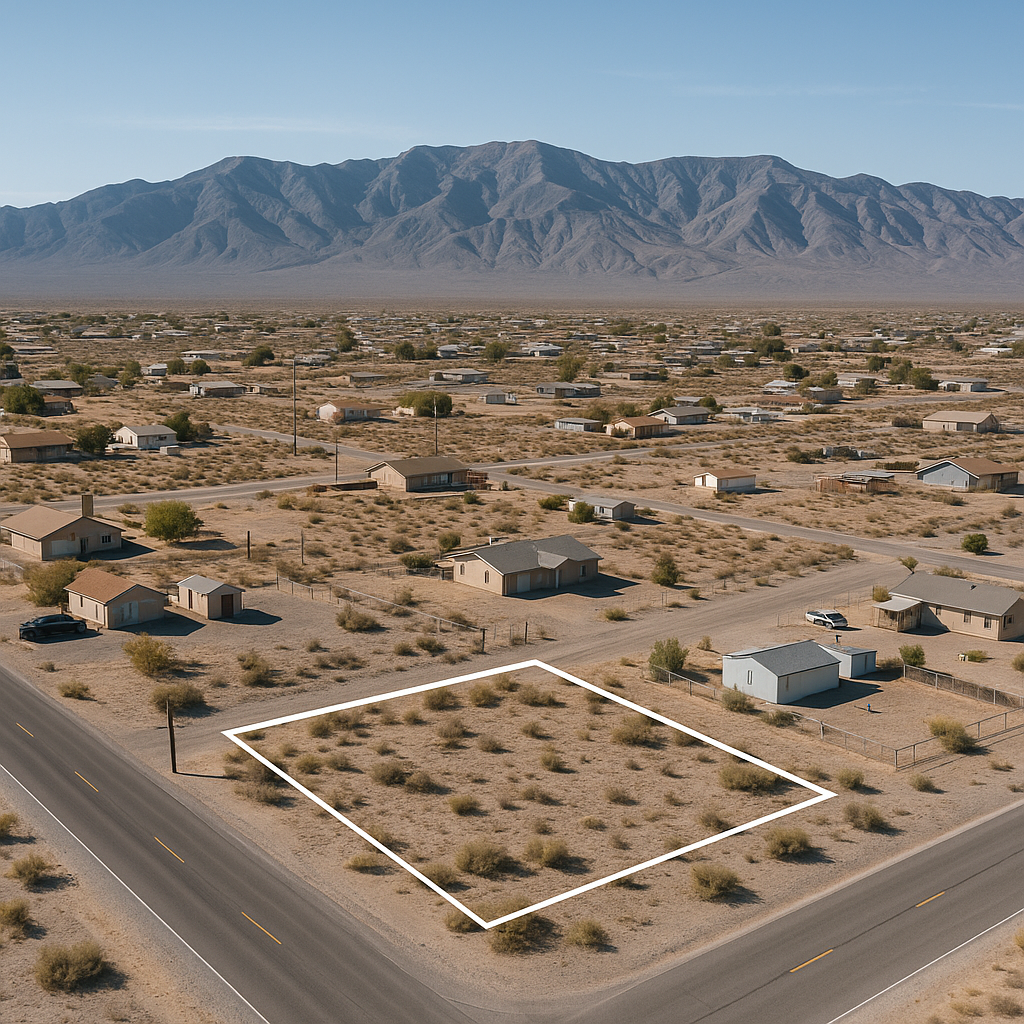
A lot described as having “utilities” is not automatically ready for a builder’s acquisition list. For off-market Pahrump lots with utilities, the useful question is narrower: which service, at which point, for this exact parcel, and what documentation supports the claim?
This case-study framework from Ultimate Land Deals is designed for absentee owners and buyers evaluating an off-market conversation before price becomes the only issue. The publisher’s existing Pahrump guide describes off-market lots as properties sold through direct deals rather than public MLS-style listings, including vacant or partially improved parcels with or without utilities. Read the Pahrump off-market lots guide.
The case: a lot marketed with a single utility label
Imagine a builder receives an off-market opportunity for a vacant Pahrump lot. The seller or intermediary says it has “utilities nearby.” That phrase may be a helpful lead, but it is not a development conclusion.
The acquisition team should not turn the statement into “utility-ready” in its internal underwriting. Instead, it opens a short verification file and separates the claim into individual questions:
| Claim in the conversation | Question that changes the decision | Evidence to request or obtain |
|---|---|---|
| “Water is available” | Is there a documented service option for the exact parcel, or is the claim based on nearby development? | Written utility or agency response, service information, and parcel identification |
| “Sewer is nearby” | Is the property actually eligible for the stated service, and what work or approvals would the buyer need to investigate? | Written confirmation tied to the parcel and the proposed connection concept |
| “It can use a well” | What records or conditions apply to this parcel’s water situation? | Parcel-specific agency guidance and relevant map review |
| “Septic is fine” | What should be reviewed before treating onsite sewage as part of the plan? | Direction from the responsible program or local authority, plus available parcel records |
| “Power is at the road” | Where is the relevant infrastructure in relation to the parcel, and what does the provider say about service? | Provider confirmation and a map or field-based record |
This is not semantic caution. A lot can be attractive while one or more utility questions remain unresolved. The disciplined buyer keeps the lot in the opportunity pipeline, but prices and contract terms it as an opportunity with open diligence—not as a finished building site.
Why Pahrump requires parcel-level utility review
The phrase “Pahrump” does not resolve the water question. Nevada’s Division of Water Resources publishes several mapping applications, including a Pahrump Water Relinquishment Web Map for parcels where water rights have been relinquished. Its web-map page also lists hydrology, water-rights, and water-use applications. Those resources are useful starting points for a parcel file, not substitutes for a parcel-specific determination. Nevada Division of Water Resources web map applications.
For a buyer, the practical lesson is simple: do not infer a parcel’s water position from a neighborhood name, a road name, or a nearby house. Record the APN, legal description, and map location used for every inquiry so that the response can be matched to the same land being considered.
Onsite sewage should receive the same treatment. Nevada’s environmental agency maintains an Onsite Sewage Disposal System Program, which signals that onsite sewage is a distinct subject for review rather than an assumption attached to vacant land marketing. NDEP Onsite Sewage Disposal System Program. A buyer considering an onsite approach should ask the responsible authority what information is needed for that parcel and proposed use; a seller should avoid representing that a septic solution is approved unless they can produce current, parcel-specific support.
A usable acquisition file: four utility statuses
The strongest case-study result is often not a yes or no. It is a clean classification that tells the buyer what to do next.
1. Documented
A service statement, map, letter, prior record, or other documentation identifies the exact parcel and supports a narrow claim. The buyer should still read what the document actually says. “Documented” does not mean every construction, connection, or approval issue has been resolved.
2. Indicated, not confirmed
There may be visible nearby infrastructure, neighbor information, an old listing statement, or a general map reference. This status is useful for prioritizing outreach, but it should not be presented as a confirmed utility condition in a purchase recommendation.
3. Requires agency or provider review
The available material does not answer the question. This is common and is not necessarily a reason to reject a lot. It is a reason to define a due-diligence task, assign it to a responsible person, and decide whether the anticipated project justifies further work.
4. Conflicting or unclear
Different materials point in different directions, a record cannot be tied to the parcel, or the seller’s description is broader than the available documentation. Treat this as a pricing and contract-risk issue. The correct next step is clarification, not a favorable assumption.
The decision point: utility-ready inventory or utility-review inventory?
For builders looking for off-market Pahrump lots with utilities, the practical split is between two pipelines.
Utility-ready candidates have enough parcel-specific support to move toward a detailed acquisition review. The support should be retained in the deal file and checked against the intended project.
Utility-review candidates may still be worthwhile, especially where location, size, or acquisition price is compelling. But they need written diligence items and a clear internal label. Calling them “utility-ready” too early can distort land basis, build timing, and the comparison with competing lots.
An owner can make this process easier without promising more than they know. A concise seller packet can include:
- the APN and legal description;
- the current deed or available ownership records;
- any prior utility correspondence, surveys, reports, or invoices;
- the source and date of each utility statement;
- a list of items the owner does not know; and
- permission for a serious buyer to pursue parcel-specific inquiries.
The packet does not need to prove every development outcome. Its value is that it makes unknowns visible early.
Choosing a sale route when utilities are still an open question
The best sale route depends partly on how much marketing and diligence coordination the owner wants to undertake.
| Route | Useful when | Utility-related tradeoff to consider |
|---|---|---|
| Direct buyer | The owner wants to discuss the parcel with a buyer that can evaluate land directly | Ask for the utility assumptions, diligence period, assignment rights, closing responsibilities, and any conditions to be written into the offer |
| Land agent | The owner wants broader market exposure and help positioning the property | The listing language should distinguish records from assumptions; ask how utility questions will be handled with prospective buyers |
| Independent sale | The owner is prepared to assemble records, answer inquiries, and manage outreach | The owner must be especially careful not to advertise nearby infrastructure as confirmed service to the parcel |
Ultimate Land Deals publishes information for Pahrump owners about direct, off-market land transactions. If an owner considers any direct offer, the productive question is not simply “Does the buyer say utilities are available?” It is “What has the buyer verified, what remains open, and how are those items treated in the written agreement?” Company-specific transaction terms should be confirmed in the actual offer and closing documents.
A short buyer-and-seller script
Before presenting a lot as utility-ready, either side can use these questions:
- What exact parcel identifier is being used for this inquiry?
- Which utility or onsite system is being discussed?
- Is the statement based on a document, a map, a visual observation, or a prior conversation?
- Who issued the information, and when?
- Does the information identify this parcel, rather than the general area?
- What remains to be reviewed before a builder relies on the answer?
- Will the purchase agreement identify unresolved utility items and the buyer’s review rights?
That process is more useful than a broad “utilities available” label because it protects both sides from treating an early marketing statement as a final site conclusion.
FAQs
Does “utilities nearby” mean a Pahrump lot has utilities?
No. It describes proximity, not confirmed service to the parcel. Ask what utility is meant and request information tied to the exact APN or legal description.
What water-related resource can I review for a Pahrump parcel?
The Nevada Division of Water Resources lists a Pahrump Water Relinquishment Web Map as well as water-rights, water-use, and hydrology map applications. Use them as research tools, then seek parcel-specific guidance where needed. Division of Water Resources maps.
Should a seller describe a lot as septic-ready?
Only if the seller has current, parcel-specific support for that statement. Otherwise, describe the available records factually and leave the determination to the responsible authority and the buyer’s diligence.