
Florida Coastal Teardown Lots: Coastal Review Questions
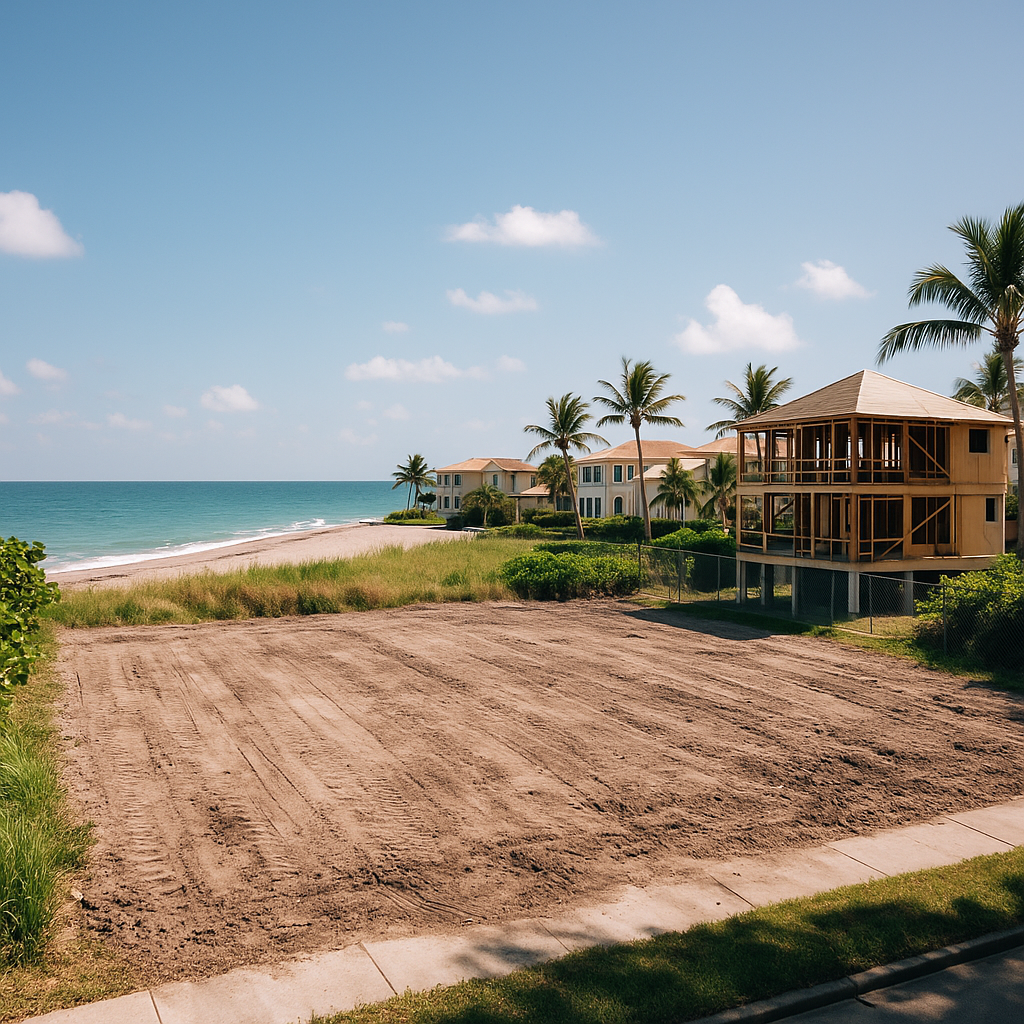
A Florida coastal house marketed as a teardown calls for parcel-specific review before a buyer prices a replacement project. The useful starting point is the property record, the intended concept plan, and the questions that apply to the particular shoreline and jurisdiction.
This guide from Ultimate Land Deals outlines state coastal issues to screen early. It is not a substitute for site-specific survey, permitting, engineering, title, or legal review.
Coastal references to check early
Before estimating demolition or construction costs, identify these references for the parcel:
- Property boundaries and recorded coastal information. DEP states that its CCCL-related survey and mapping data are for informational purposes and that official information must be obtained from the record plat filed with the clerk of circuit court for the appropriate county. Review the recorded information and determine what survey work is appropriate for the proposed project. DEP regional coastal monitoring data
- The Coastal Construction Control Line (CCCL), if established for the area. Florida law provides for CCCLs on a county basis along specified sand beaches and requires special siting and design considerations seaward of an established line. DEP describes the CCCL program as regulating structures and activities that can affect erosion, dunes, upland property, or public access. Florida Statutes § 161.053 and DEP’s CCCL Program
- The mean-high-water relationship where the 50-foot rule may apply. Section 161.052 generally restricts excavation or construction of listed structures within 50 feet of mean high water at qualifying riparian coastal locations fronting the Gulf of America or Atlantic coast. The provision excludes bays, inlets, rivers, bayous, creeks, passes, and similar waters from that stated scope and includes waiver, variance, and other provisions. Evaluate the shoreline type and conditions for the particular parcel rather than applying the rule from an aerial image. Florida Statutes § 161.052
Questions a teardown listing does not answer
A teardown label does not resolve the questions that matter for a proposed replacement home. Before underwriting a project, ask the applicable local planning, zoning, and building offices:
- What zoning district, dimensional standards, overlays, and demolition procedures apply?
- What information is needed to review the proposed footprint, height, access, utilities, and drainage approach?
- Are there local coastal, historic, tree, floodplain, or other review requirements for the proposed work?
- What permits, records, surveys, or agency reviews should be obtained before submitting an application?
Ask these questions against a preliminary concept plan. A broad answer to whether a lot is “buildable” may not address the dimensions or placement of the home being considered.
Screen CCCL status before committing to a design
A waterfront address alone does not establish CCCL status. DEP explains that adoption of a CCCL establishes an area of jurisdiction where special siting and design criteria apply to construction and related activities. Review available DEP information as an initial screen, then verify the relevant recorded coastal information and the parcel’s relationship to it. DEP’s CCCL Program
A practical initial file can include:
- parcel ID, legal description, county, and municipality or unincorporated-area status;
- current deed and title materials for title review;
- available assessor and aerial references, treated as preliminary;
- available coastal permit records and CCCL information;
- a current or proposed boundary/topographic survey; and
- a preliminary replacement-home massing or footprint concept.
Florida’s coastal rules page identifies Rule 62B-33 as covering procedures for individual permits for construction or activities seaward of a CCCL and the 50-foot setback. DEP Beaches and Coastal Systems Rules & Statutes
Review the existing house and property records
The existing house, its permits, and prior surveys can provide useful history. Obtain and review records relevant to the intended work, including:
- prior building, demolition, coastal, and environmental permits;
- certificates of occupancy or final inspections, where available;
- surveys used for prior work;
- open permits, notices, or code-enforcement records; and
- recorded easements, access documents, and title exceptions.
For a proposed replacement, ask the applicable authorities how they will review demolition, construction, and the proposed plan.
Address coastal disclosures in the contract process
For property located partially or totally seaward of the CCCL, Florida law requires the seller to provide the statutory coastal-property disclosure at or before both parties execute the purchase contract. Unless the purchaser waives the material in writing, the seller must provide an affidavit or a qualifying survey delineating the CCCL location at or before closing. The statute also provides that failure to deliver these items does not impair contract enforceability, create a rescission right, or impair title. Florida Statutes § 161.57
The disclosure is not a feasibility approval. Coordinate the review of coastal information with the seller, title company, surveyor, counsel, and other appropriate professionals.
Confirm applicable construction requirements
The Florida Building Commission identifies the Florida Building Code, 8th Edition (2023), as effective December 31, 2023. Confirm with the applicable permitting authority which requirements apply to the planned application and project. Florida Building Commission
FAQs
Is every waterfront Florida lot subject to the CCCL?
No. Determine whether a CCCL has been established for the area and verify the parcel’s relationship to the relevant recorded coastal information.
Can a buyer rely only on mapping or aerial imagery?
Use available mapping and imagery for preliminary screening, then obtain the recorded coastal information and determine what survey and professional review are appropriate for the proposed project.
Does an existing coastal home answer the replacement-home question?
No single fact about an existing home resolves review of a proposed replacement. Obtain relevant property records and ask the applicable authorities how they will evaluate the demolition and proposed construction.
Sources
- Florida DEP Coastal Construction Control Line Program
- Florida Statutes § 161.053, Coastal construction and excavation
- Florida Statutes § 161.052, Coastal construction and excavation; regulation
- Florida Statutes § 161.57, Coastal properties disclosure statement
- DEP Regional Coastal Monitoring Data
- Florida Building Commission