
Cape Coral Saltwater Lots: Riparian-Rights Records to Review
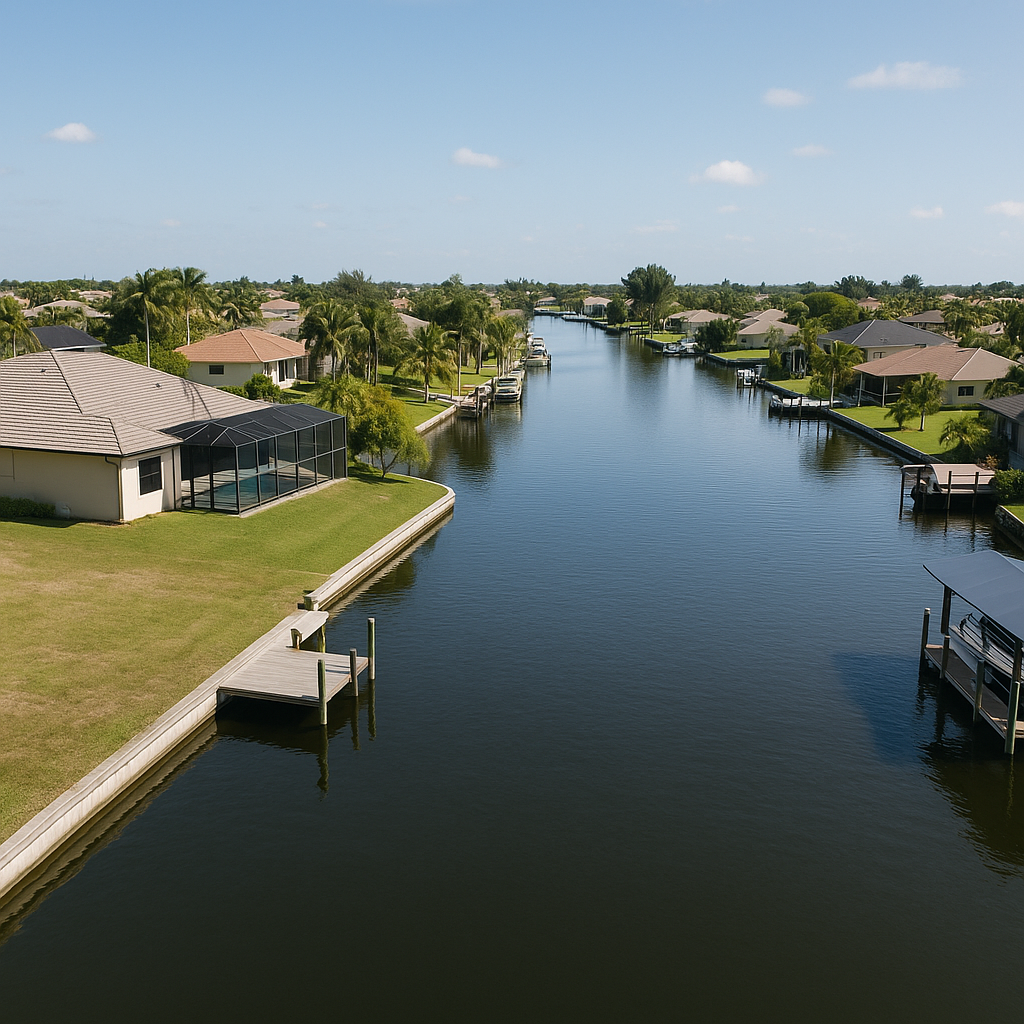
Cape Coral Saltwater Lots and Riparian Rights: Records to Review
A canal-side or “saltwater” description does not by itself answer where title ends, whether statutory riparian rights attach, or whether a proposed waterfront improvement involves state-owned submerged land. The useful starting questions are narrower: What upland is being sold, what waterbody borders it, and what specific use or improvement is under consideration?
Ultimate Land Deals publishes this informational guide for owners seeking careful, document-based language while they decide what property records to gather.
What Florida’s riparian-rights statute says
Florida Statutes § 253.141 defines riparian rights as rights incident to land bordering navigable waters. The statute identifies rights of ingress, egress, boating, bathing, and fishing, while recognizing other rights defined by law. It also says that these rights are not proprietary, are appurtenant to and inseparable from the riparian land, and run with a conveyance or lease of qualifying upland even if not mentioned in the deed or lease.
Under the same statute, title to the land must extend to the ordinary high watermark of the navigable water for riparian rights to attach. Florida Statutes § 253.141
That statutory framework is a reason to avoid treating “waterfront,” “saltwater,” and “riparian rights” as interchangeable listing terms.
Do not infer underwater ownership from an upland description
DEP describes sovereignty submerged lands as including tidal lands and lands waterward of the ordinary or mean high-water line beneath navigable fresh water or tidally influenced waters. DEP says title to sovereignty submerged lands is held by the Board of Trustees of the Internal Improvement Trust Fund. Florida DEP: Submerged Lands Management
That general state-land framework does not decide title or jurisdiction at a particular canal edge. It does support a careful approach: do not represent canal-bottom ownership merely from an upland deed, a water view, or the word “saltwater.”
| Description | What to review before making a broader claim |
|---|---|
| “The lot has riparian rights.” | The title boundary, the applicable ordinary-high-water-boundary question, and whether the statutory navigable-water framework applies. |
| “The lot is on a saltwater canal.” | The particular canal reach and the proposed use. |
| “There is water behind the lot.” | Survey, title, plat, and records relevant to the water edge. |
| “A neighbor has a dock or seawall.” | Records and review applicable to the specific parcel and proposed work. |
Build a short property-record memo
A one-page memo will not resolve title or legal questions, but it can separate documents in hand from questions that remain open.
1. Identify the upland
Collect the legal description, parcel identification information, deed, available survey, plat, and title materials. Record what the documents actually show at the water edge. If water-boundary language is unclear, ask a title professional or Florida real-estate attorney what the document establishes.
2. Describe the waterbody without adding conclusions
Use the canal location or identifier shown in available records. Avoid adding labels such as “navigable,” “tidal,” “gulf access,” or “private canal” unless a parcel-relevant record supports them.
3. Separate existing features from planned work
Record what is physically present—such as a seawall, concrete area, dock-like structure, or boat lift—and keep that separate from questions about repair, replacement, expansion, or new construction. Review available records for the feature and identify the proposed scope precisely.
The linked City document is titled “Seawall (with or w/o Concrete Dock) Guideline — Residential.” It lists application, site-plan, and plan/specification materials and refers to DEP approval or SAJ-91 except for freshwater. The document also states that the guidelines are subject to change without notice, so confirm current requirements with the responsible office for the actual project. City of Cape Coral residential seawall guideline
4. Raise the state-land question when appropriate
DEP’s Submerged Lands Management page identifies submerged-land leases, easements, renewals, modifications, and assignments to new upland owners among the correspondence it processes for local-government issues involving state-owned lands. It also directs people seeking to apply to use state-owned submerged lands to contact their local district. Florida DEP: Submerged Lands Management
For proposed work that may extend waterward of the title or survey boundary, keep the parcel identifier, legal description, survey if available, a location sketch, and a plain-language project description together when requesting parcel-specific guidance.
Comparing sale approaches
The sale route does not change the need for accurate waterfront wording.
- Direct sale: Ask what waterfront assumptions, review period, records, and closing conditions are written into the offer.
- Listing with an agent: Request wording that distinguishes documented facts from matters for buyer due diligence.
- Independent sale: Provide serious prospects with the same available file and identify unknowns without interpreting title boundaries or state-land status beyond the records.
Compare the written price, requested review rights, closing conditions, expected documents, and the assumptions each party is making.
Careful interim wording
Until parcel-specific review is complete, a restrained description may be more useful than a broad waterfront claim:
Vacant upland parcel adjoining a canal. Available owner records include [list only documents actually in hand]. Buyer should independently review title boundaries, any riparian-rights analysis, submerged-land status, and feasibility of a proposed waterfront improvement.
FAQs
Are riparian rights a separate asset that can be sold apart from the lot?
Section 253.141 says riparian rights are appurtenant to and inseparable from qualifying riparian land, and that they run with a conveyance or lease of that upland. Florida Statutes § 253.141
Does the word “saltwater” establish canal-bottom ownership?
Do not draw that conclusion from the label alone. DEP’s description of sovereignty submerged lands identifies categories of lands waterward of the ordinary or mean high-water line and states that title to sovereignty submerged lands is held by the Board of Trustees. Parcel-specific title and boundary records remain important. Florida DEP: Submerged Lands Management
What documents should an owner begin with?
Begin with the legal description, deed, available survey, plat, title materials, and available records concerning any existing water-edge feature. Identify missing records rather than filling gaps with assumptions.