
Cape Coral Saltwater Lot Dock Permit Requirements
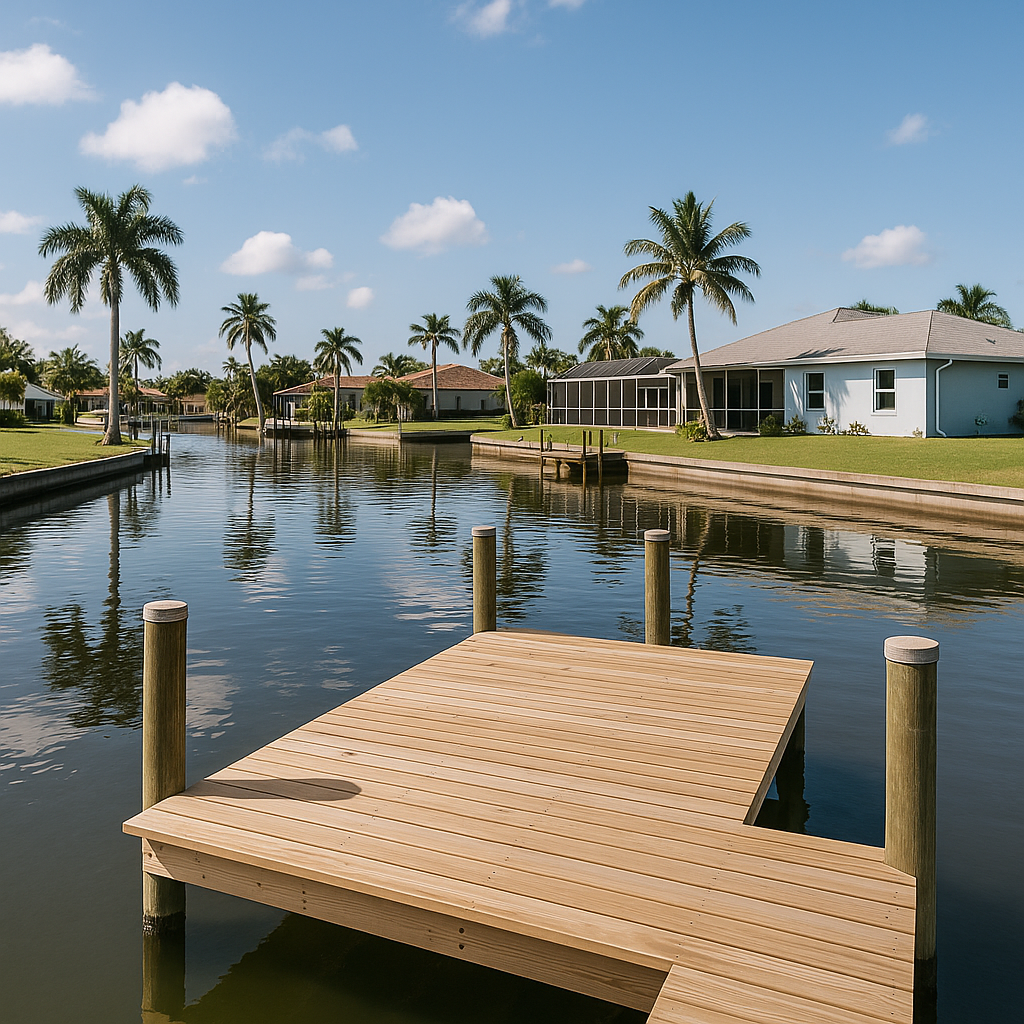
A saltwater canal label does not establish that a proposed dock can be built, how it must be designed, or which approvals apply. Before buying a Cape Coral waterfront lot for dock use, build a written feasibility file around the exact parcel, the exact dock concept, and the agencies’ written answers. That is more useful than treating an existing dock on another lot—or a seller’s statement—as a permit conclusion.
Ultimate Land Deals publishes this guide for owners and buyers reviewing vacant Florida land. Its About page describes its focus on purchasing vacant land in Florida through a digital process; a prospective seller should still confirm the terms, contingencies, and intended use assumptions in any written offer.
Start with the dock concept, not the word “dock”
Write down what the buyer actually wants to place at the water’s edge. A bare statement such as “dock potential” leaves too much unanswered. Make a one-page project description before requesting agency guidance:
- the parcel address, parcel number, and legal description;
- the intended dock location along the parcel’s water frontage;
- whether the proposal is new construction, repair, replacement, or an addition to an existing structure;
- whether a boat lift is part of the plan;
- the intended use, including the type of vessel the buyer expects to keep there; and
- the survey, photographs, prior plans, permits, or correspondence available from the seller.
This description is not a permit application. It gives the City and state reviewer something specific to evaluate. If the plan changes materially after an answer is received, ask again rather than assuming the earlier response carries over.
Treat feasibility as four separate questions
A useful purchase decision separates issues that are often compressed into the phrase “dock permit.” The following matrix helps identify what must be verified instead of guessed.
| Question | What to ask for | Why it should remain separate |
|---|---|---|
| Does the parcel have the waterfront area needed for the concept? | A current survey or other parcel-specific waterfront documentation, plus the proposed dock location | Canal frontage and a buildable dock layout are not the same conclusion. |
| What is already on or associated with the site? | Existing plans, permits, notices, photographs, and any prior agency correspondence | An existing improvement or old paperwork does not, by itself, answer what a new proposal may require. |
| What does the City require for this described work? | Written direction from the responsible City permitting staff, tied to the parcel and project description | Local review should be confirmed rather than inferred from a nearby property. |
| Is a state environmental authorization, exemption, or verification involved? | Direction from the appropriate Florida Department of Environmental Protection office or portal | State review is a separate track from City communication. |
A buyer who receives only a verbal “should be fine” has not yet resolved these questions. Ask for the relevant response in writing, retain the description submitted with it, and note the date.
Use the City material as a project-screening tool
Cape Coral makes a residential New Wood Dock guideline available in its permit document center. Review it before approaching the City, then ask the City which parts apply to the actual project. Do not turn the document’s existence into a conclusion that a particular lot qualifies.
The same caution applies where the dock discussion involves shoreline work. Cape Coral also provides a residential Seawall guideline. Keep the two scopes distinct in your file: a dock question can become more complicated if the buyer is also contemplating a seawall-related project. Ask the City whether the proposed work should be reviewed together or as separate scopes.
Bring drawings or a clearly marked sketch if the agency requests them. The point is not to produce a construction-ready design prematurely; it is to prevent an agency from answering a vague question that later proves to describe a different project.
Ask the state question directly
The Florida Department of Environmental Protection states that its Environmental Resource Permitting program regulates most alterations to Florida land surface that are not exempt under statute or rule. It also states that the State 404 Program addresses dredge or fill activities within state-assumed waters. The Department directs applicants to contact the district office in which the project is located to determine the required permit type. FDEP ERP e-Permitting
For certain single-family dock projects, FDEP’s page describes an online self-certification process through which a user enters information and certifies that the project is exempt from requiring a DEP permit. The listed project types include a new dock with or without a boat lift, repair or replacement of an existing dock, and adding a boat lift to an existing dock. FDEP says there is no fee for that self-certification process. That is not a blanket finding for a Cape Coral lot: the buyer must determine whether the particular project qualifies and should ask FDEP when uncertain. FDEP ERP e-Permitting
A focused state inquiry can read:
“I am evaluating a proposed [new dock / repair / replacement / boat-lift addition] at [parcel address and parcel number]. Attached are the available survey, site sketch, and waterfront photographs. Please advise whether the proposed scope appears to need a DEP authorization, a verification of exemption, or another submission, and identify the next step for this location.”
Do not represent the project as exempt merely because it resembles one of the categories listed on the portal. The qualification decision belongs with the responsible agency and the submitted project facts.
Make dock feasibility a purchase-decision item
For a buyer, the central question is not simply “Can I get a permit?” It is: What level of unresolved dock risk am I accepting at this price? There are three practical positions:
- Buy only after written agency direction. This suits a buyer whose planned dock use is essential to the purchase. It can take more pre-closing work, but it reduces reliance on marketing language.
- Buy with a defined review period. The buyer identifies the records needed, the agencies to contact, and what answer would change the decision. The purchase document should state the review rights and timing rather than relying on an informal understanding.
- Buy as-is with dock feasibility unresolved. This can fit a buyer who has priced the uncertainty into the acquisition. It is not appropriate if the buyer’s value assumption depends on a specific dock outcome that has not been checked.
Sellers should request that a prospective buyer say which of these positions it is taking. If an offer depends on dock feasibility, ask what documents the buyer needs, whether it has an inspection or review contingency, whether it may assign the contract, and who is responsible for agency inquiries. Those written details are more informative than an offer’s headline price.
If you are selling the lot instead of building
A direct buyer, a waterfront-focused real-estate agent, and an independent sale can each be workable routes. The difference is not just price; it is who will gather, explain, and accept unresolved dock questions.
- Direct buyer: Ask whether the buyer is valuing the land as having unverified dock potential or expects a particular feasibility finding. Confirm closing timing, due-diligence rights, assignment rights, and any seller document requests in writing.
- Agent listing: An agent may help present the available file to a broader buyer pool. Ask how permit-related representations will be described and whether buyers will be told to conduct their own agency review.
- Independent sale: The owner controls the communications and can provide the same organized file to each prospect. Avoid promising a permit result that has not been confirmed.
For an absentee owner, a clean digital folder can make any route easier: deed or title material available to the owner, survey, waterfront photographs, past permits, City or FDEP correspondence, and a short chronology of what is known versus unverified.
Questions to resolve before calling a lot “dock-ready”
- Is the property actually within the jurisdiction addressed by the agency materials being reviewed?
- What exact structure and related work is proposed?
- What existing documentation applies to this parcel, rather than to a neighboring lot?
- What does the City say is needed for the described scope?
- What does FDEP say about the applicable authorization, exemption verification, or submission path?
- Which conclusions are written agency responses, and which are merely assumptions by a seller, buyer, or contractor?
Resources
- Cape Coral residential New Wood Dock guideline
- Cape Coral residential Seawall guideline
- Florida DEP ERP e-Permitting
FAQs
Does “saltwater lot” mean a dock permit will be approved?
No. The description does not resolve the parcel-specific dock layout, City review, or state authorization question. Obtain written direction for the actual proposal.
Can a buyer use FDEP self-certification for a new dock?
FDEP lists new single-family docks, with or without boat lifts, among the project types addressed by its self-certification process. The buyer must determine whether the specific proposal qualifies and should contact the appropriate district office when needed. FDEP ERP e-Permitting
Should a seller obtain a dock permit before listing?
That depends on the seller’s goals and the condition of the file. A seller who does not intend to build can instead organize existing parcel records and avoid making unverified feasibility claims. A buyer whose purchase depends on a dock can pursue its own project-specific review.
Is a seawall question automatically part of the dock question?
Not necessarily. Keep the scopes separate and ask the City whether the proposed work should be reviewed together or independently, particularly when shoreline work is contemplated.