
Cape Coral Gulf Access Bridge Clearance Guide
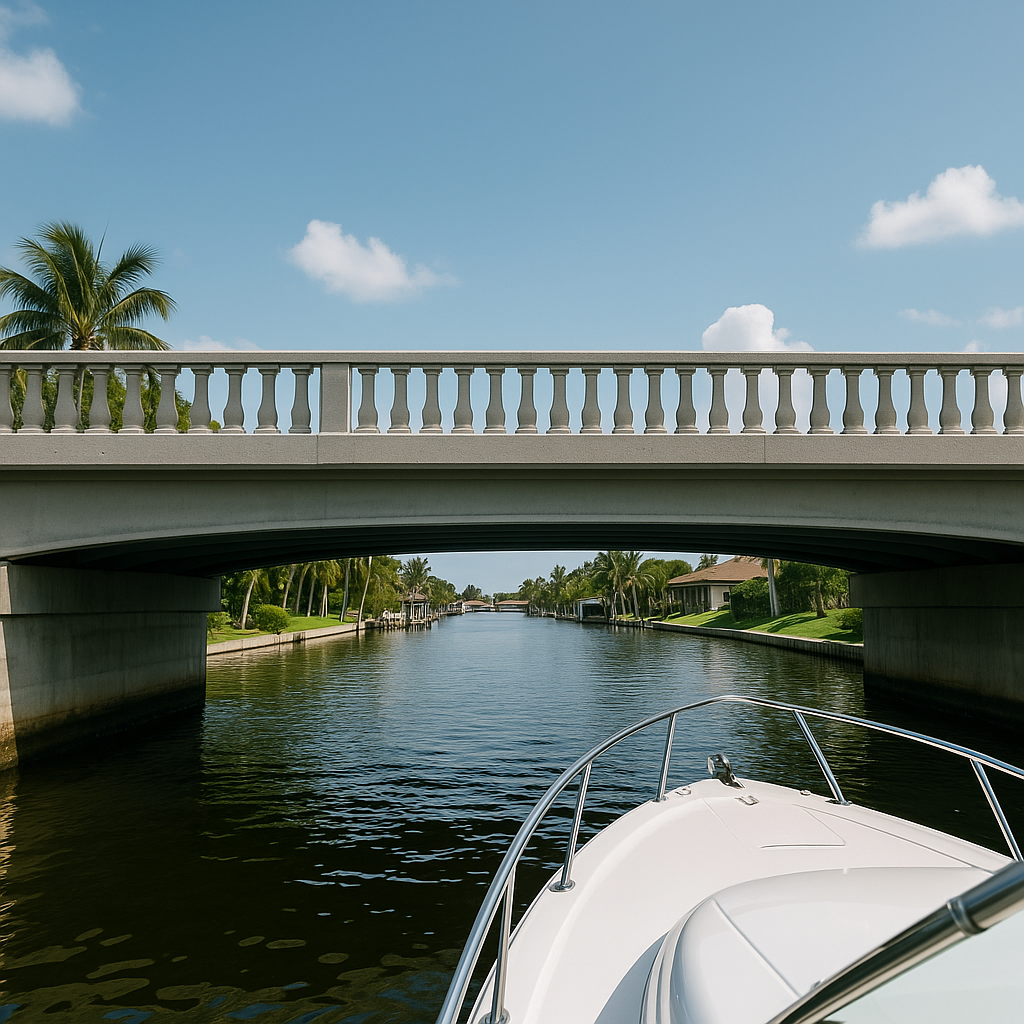
A Cape Coral lot’s claimed gulf access is only as useful as the route between that lot and open water for the boat a future owner actually expects to use. A bridge clearance is not a marketing detail to take on faith: it is a route-and-vessel question. Before pricing, buying, or selling a waterfront parcel, identify the proposed route, every potential restriction on it, and the source that confirms each item.
Ultimate Land Deals publishes this guide for absentee owners evaluating an off-market waterfront-lot conversation. Its published Florida guide describes a direct, digital land-sale process and says the company evaluates parcels for purchase, assignment, or resale; any buyer’s price, review period, assignment rights, and closing terms should still be read in that buyer’s written offer. Ultimate Land Deals’ Florida guide
Start with the boat, not the phrase “gulf access”
“Gulf access” can conceal the question that affects practical appeal: access for what vessel, on what route, under what operating conditions? A buyer considering a low-profile skiff may assess a route differently from a buyer who expects a boat with a fixed tower, hardtop, antenna, or other height above the waterline.
Do not try to resolve that difference by labeling a parcel simply “bridge-free,” “sailboat access,” or “restricted” unless a current, parcel-specific route review supports the statement. Instead, create a working description:
- Proposed departure point: the parcel’s canal frontage or the planned dock location.
- Intended destination: the waterway or inlet the buyer regards as open-water access.
- Vessel profile: the boat type and its height above the waterline, including fixed equipment.
- Route constraints to investigate: bridges, locks, posted operating information, turns, canal dimensions, and any other features a local boating authority or marine professional identifies.
- Evidence date: when each source, observation, or response was obtained.
This is more useful than a broad access label because it shows a prospective buyer exactly what has been checked and what remains unknown.
Build a route sheet from the lot outward
A route sheet is a one-page document that prevents a common mistake: checking a prominent bridge near the property while overlooking another feature farther along the trip.
1. Mark the parcel’s actual water connection
Use the parcel’s location and waterfront edge as the starting point. Do not assume that two nearby lots share the same practical route because they have similar street addresses or are in the same general neighborhood. Ask the relevant city contact or a qualified local boating professional to identify the route they would use from that specific location.
Cape Coral maintains a boating information page, which is a sensible starting point for locating current city boating information and contacts. City of Cape Coral: Boating
Record the route in sequence. A plain list is enough:
- Parcel canal or basin
- First connecting waterway
- Each bridge or controlled feature encountered
- Final connection toward the intended destination
If you cannot confidently identify the route, say so. A buyer can then decide whether to make route verification part of its review rather than relying on an unsupported representation.
2. List every crossing separately
For each bridge, leave room for the facts that matter rather than entering a single unverified clearance number.
| Route item | What to record | Question to resolve |
|---|---|---|
| Bridge identification | Name, location, or other identifying description | Is this the correct crossing on the proposed route? |
| Vertical clearance information | The source, date, and exact wording provided | How is clearance measured, and what water condition does the information use? |
| Operating status | Any current information from the responsible contact | Are there current restrictions, closures, or operating changes to confirm? |
| Vessel comparison | Intended vessel height above waterline | Does the vessel fit the verified condition with an appropriate margin? |
| Alternative path | A separately verified alternate route, if one exists | Does it introduce different crossings or limitations? |
The purpose is not to make the owner a navigation expert. It is to stop a vague access claim from becoming the basis of the price.
3. Treat locks as a separate routing question
A lock should not be reduced to “good” or “bad” access. For a lot buyer, the useful questions are operational:
- Is a lock on the route being evaluated?
- Does the intended boat fit the lock’s current operating conditions?
- Who provides current operating information?
- Does the buyer regard using that lock as acceptable for the intended boating use?
- Is the proposed route still the route a buyer would use after reviewing all crossings and connections?
Put the answers in writing from the responsible source or make them explicit buyer due-diligence questions. Do not infer a lock’s availability, schedule, capacity, or rules from an old listing description.
Use published navigation material as a research lead, not a parcel guarantee
NOAA publishes U.S. Coast Pilot materials, including Chapter 4 and Chapter 12. For an owner or buyer, the productive use of those materials is to identify questions and confirm which current navigation resources or authorities apply to the proposed route.
A published resource does not, by itself, prove that a particular Cape Coral lot has a usable route for a particular vessel. Before relying on any map, chart, listing, screenshot, or secondhand clearance statement, ask:
- Does this source identify the exact crossing and waterway on my route?
- Is it current enough for the decision being made?
- Does it address the relevant vessel configuration?
- Who can confirm the current condition if the material is unclear or conflicts with another source?
- What assumption would change the buyer’s offer or intended use?
This approach is especially important for absentee owners. You do not need to make a conclusion from afar; you need a clean record that lets a buyer evaluate the conclusion responsibly.
Separate waterfront appeal from route certainty
A waterfront parcel can have appeal even when the route has unresolved questions. The mistake is pricing or advertising the unresolved question as settled. Keep these two statements separate:
- Observable condition: the parcel has waterfront frontage or a visible canal connection.
- Unverified conclusion: a stated boat type can reach the Gulf without a material limitation.
Only make the second statement when current route-specific evidence supports it. If the route is still being reviewed, a more accurate discussion is: “Buyer should verify bridge, lock, and vessel-clearance compatibility for its intended route.” That wording is not a substitute for research; it identifies the research that belongs in the buyer’s decision.
Compare sale paths by how they handle the access question
Bridge-clearance uncertainty does not dictate one selling method. It does change what should be discussed before accepting a price.
Direct land buyer
A direct buyer may be practical when an owner wants one party to review the route question and present written terms. Ask the buyer what it has assumed about the route, whether access verification is a condition of its purchase, whether it may assign the agreement, and who will coordinate closing. Ultimate Land Deals states that it works with direct land purchases, contract assignments, and resales, but those choices and all transaction terms should be confirmed for the specific parcel in writing. Ultimate Land Deals’ Florida guide
Agent-assisted sale
An agent may help expose the lot to waterfront-oriented buyers. Before authorizing marketing language, require the agent to distinguish documented route facts from claims a buyer must verify. Ask how the listing will describe bridge clearance, locks, and boat compatibility without overstating them.
Owner-led sale
A seller marketing independently can provide the route sheet, photos, and source links directly to prospects. That route demands discipline: distribute the same record to each serious buyer, avoid filling evidence gaps with assurances, and place any important access assumption in the written agreement or buyer communication.
The right comparison is not simply list price. Compare the proposed price with the amount of access-related uncertainty each route leaves with you, the buyer’s review rights, the possibility of assignment, and the written closing process.
A short file to prepare before discussing price
Keep the package focused on the access decision:
- Parcel identifier and waterfront location
- A sketch or map showing the proposed route in order
- A bridge-and-lock route sheet with dates and sources
- Current contact details for the party that can answer unresolved operational questions
- Photos or video that are clearly labeled by date and location
- A written list of statements you are not making, such as guaranteed clearance for a particular boat
- Each buyer’s written assumptions, contingencies, assignment language, and closing terms
That file lets a credible buyer underwrite the actual question rather than discounting the lot because the route is unclear.
Resources
- City of Cape Coral boating information
- NOAA U.S. Coast Pilot 5, Chapter 4
- NOAA U.S. Coast Pilot 5, Chapter 12
- Ultimate Land Deals: Off-Market Land Deals for Developers in Florida
FAQs
Does “gulf access” tell me the bridge clearance?
No. It does not answer which route is being used, which crossings are on that route, or whether an intended vessel fits the verified conditions. Request a route-specific review.
Should I advertise a specific clearance number from an old listing?
Not without confirming that the number applies to the exact bridge, route, and current conditions relevant to the property. Preserve the old listing as background, but treat it as a question to verify rather than proof.
What if a buyer wants to use a taller boat than I expected?
Ask the buyer to provide the relevant vessel profile and identify the route it expects to use. That prevents the parties from debating a general label instead of the buyer’s actual use case.
Can a direct buyer purchase the lot while it still needs route verification?
That depends on the buyer’s written offer. Review what the buyer has assumed, what it may investigate, whether it can assign the contract, and what event allows it to withdraw or renegotiate.