
Cape Coral Canal Lot Value Estimate: A Practical Method
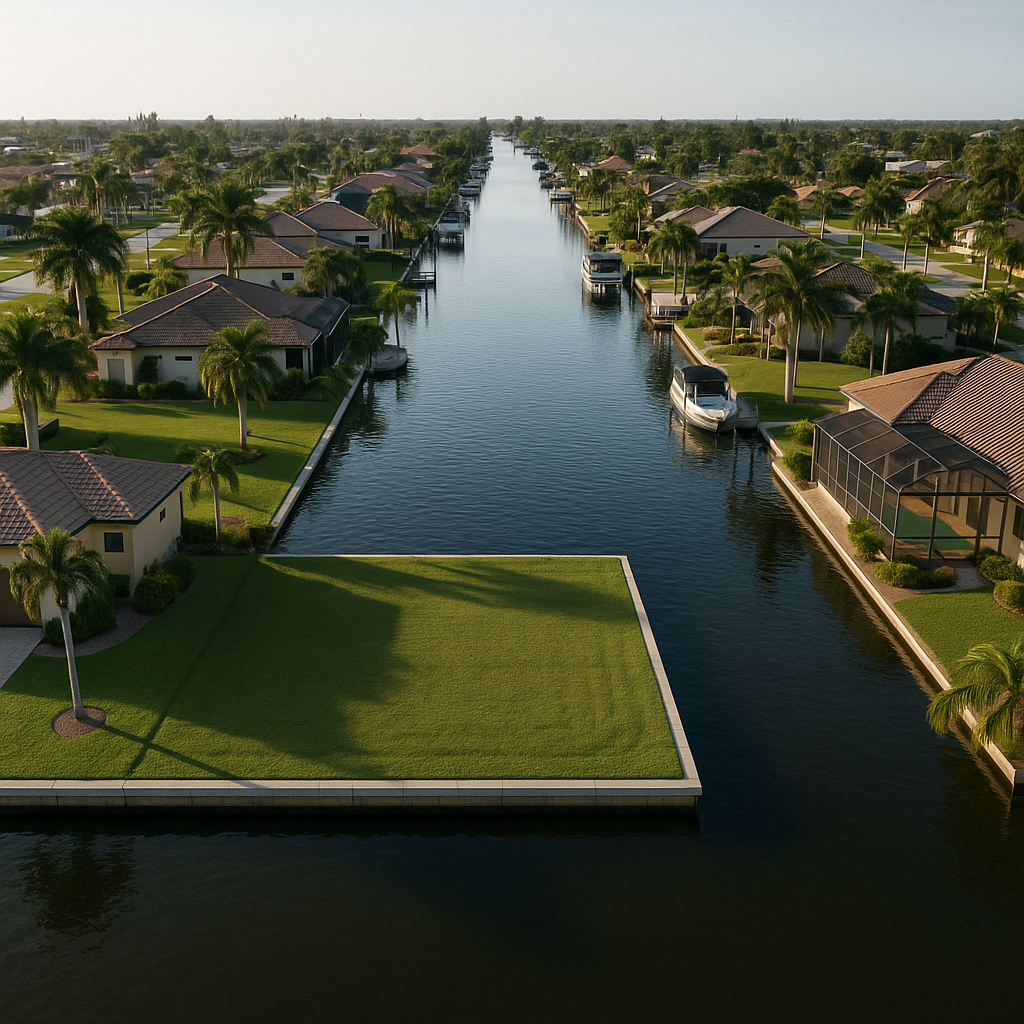
A useful Cape Coral canal lot value estimate begins with one question: what kind of water experience can a buyer actually get from this parcel?
“Canal lot” is too broad to produce a reliable number. Two lots on canals a few streets apart can have sharply different buyer pools because one is freshwater only, another reaches the Caloosahatchee River, and another offers Gulf access but requires passage under low bridges. Add a seawall question or an unpaid utility assessment, and a nearby sale can become a poor comparison.
For an absentee owner, the goal is not to find the highest waterfront sale online. It is to build a defensible range from sales that match the features a buyer will underwrite.
Start with the parcel’s water identity
Before looking at sold prices, write a one-line description of the lot that a serious buyer would recognize. It should answer more than “waterfront” or “gulf access.”
For example:
Residential canal lot with saltwater access, one bridge on the route, existing seawall status unknown, municipal utilities available, assessments to be confirmed.
Or:
Residential freshwater canal lot, boating access limited to the freshwater system, no seawall information available, utility status to be confirmed.
That description immediately separates the parcel from a large number of sales that may appear in a broad map search.
The most important distinctions are usually these:
| Feature | Why it changes value |
|---|---|
| Freshwater versus saltwater | Freshwater frontage can be attractive for views, fishing, paddling, and a pool-home setting, but it is not a substitute for navigable Gulf access for buyers who keep larger boats. |
| Gulf-access route | Buyers consider the route to open water, not merely whether a listing says “Gulf access.” Bridge clearance, locks, turns, distance, and route convenience can affect the audience for the lot. |
| Direct access versus bridge-restricted access | A no-bridge route may appeal to buyers with sailboats, tall center consoles, or a preference for uncomplicated boating. A bridge is not automatically negative; its practical clearance and location matter. |
| Canal width and setting | A wider basin, intersection view, long-water view, or more open setting may command attention over a narrow canal with close rear neighbors. |
| Seawall condition | An existing usable seawall can remove a major future project. A failing wall, uncertain condition, or lack of a wall can reduce what a buyer will pay. |
| Lot orientation and street context | Rear exposure, sun, nearby homes, traffic, and the immediate block influence how a future pool home will live and market. |
Do not assume an online listing’s waterfront label is complete. Review the parcel map, aerial imagery, and the actual route before grouping it with other sales. If the distinction is unclear, describe it conservatively until a local marine or property professional confirms it.
Build an estimate from three matched sale groups
A single “price per lot” is rarely enough for Cape Coral waterfront land. A better approach is to assemble three small groups of closed sales, then give the most weight to the group that resembles the subject parcel.
Group 1: The access match
Find recent vacant-lot sales with the same broad water category: freshwater, saltwater with bridge restrictions, or saltwater with an easier or no-bridge route. This is the group that establishes the starting range.
Do not blend freshwater sales with Gulf-access sales simply because both have canals behind them. Their buyers are often shopping for different reasons.
Group 2: The seawall match
Within the access-matched sales, separate lots with documented seawalls from those without one or with uncertain conditions. A listing that says “seawall in place” is not enough by itself; an older wall may still prompt a buyer to budget for inspection, repair, or replacement.
If your lot has a wall, collect what you can: permit information, installation year if known, recent photos, repair invoices, and any inspection records. If you do not know its condition, do not add full value for it in an estimate. Buyers tend to price uncertainty into their offers.
Group 3: The development-cost match
Then compare the utility and site-cost position. A buyer may pay differently for two otherwise similar lots if one has municipal water and sewer service with assessments paid and the other carries an unpaid balance or faces a different utility situation.
The relevant question is not simply, “Are utilities available?” It is:
What must the next owner pay, arrange, or wait for before a house can be built and connected?
Confirm assessment balances and payoff procedures with the appropriate City of Cape Coral department or through current title and closing information. County tax bills, listing remarks, and old owner notes should not be treated as final confirmation.
Reject sales that make the estimate look better but less accurate
Owners often find a high sale and assume it supports their value. It may not. Remove or heavily discount comparisons with differences that cannot be explained with a modest adjustment.
Be cautious with these sales:
- New-construction home sales. The sale price includes the house, pool, finishes, and builder margin. It may help show neighborhood demand, but it does not establish vacant-lot value by itself.
- Corner, oversized, or assemblage parcels. Extra dimensions can matter to a builder or adjacent owner in ways a standard residential lot cannot match.
- Lots with exceptional water views. A basin, intersecting canal, river view, or unusually wide water exposure may be the reason for the price rather than the general neighborhood.
- Sales recorded long after contract signing. In a fast-changing market, the contract date may better reflect the decision made by buyer and seller than the recording date alone.
- Distressed or non-market transfers. Related-party transfers, estate transfers, package sales, and unusual financing terms may not reflect open-market lot value.
- Listings that have not sold. Active asking prices show competition and owner expectations, not proof of value. Expired listings can be useful evidence that a price was not accepted.
A smaller set of genuinely comparable closed sales is more useful than a broad spreadsheet full of loosely related waterfront properties.
A practical example: why two “Gulf-access” lots may not be equal
Assume an owner sees two recent sales in the same general Cape Coral area. Both were marketed as Gulf-access lots.
- Sale A had a newer seawall, paid assessments, a broad water view, and a route with no bridge constraint.
- Sale B had an older wall, a bridge on the route, and an assessment balance the buyer had to account for.
Using Sale A as the primary comp simply because it sold for more can overstate the subject’s value. If the subject resembles Sale B in access and costs but has a better orientation, the estimate should begin near Sale B and account for the orientation advantage—not begin at Sale A and assume only a small deduction is needed.
This is the central discipline in a Cape Coral canal lot valuation: compare the whole ownership proposition. A buyer is purchasing a future homesite, a boating route, and a set of development costs together.
Turn the evidence into a range, not a single magic number
After sorting the sales, set three figures:
- Supportable market range: the range indicated by the most comparable recent closed sales after accounting for meaningful differences.
- Likely retail-listing strategy: a price intended to test the market, recognizing that it may require marketing time, buyer financing review, inspection contingencies, or price reductions.
- Direct-sale range: the amount a cash buyer may offer after allowing for due diligence risk, resale or construction costs, holding time, and the convenience of a simpler closing.
Those figures serve different purposes. A direct cash offer is not automatically evidence that the land is worth less; it reflects a different transaction structure. Conversely, a high listing price is not proof that an owner can net that amount.
For an absentee owner, compare the projected net outcome rather than only the headline price. Ask who pays closing costs, whether the buyer can extend due diligence, whether the contract can be assigned, what happens if title or seawall questions arise, and whether any assessment payoff is deducted at closing.
Documents that make an estimate more credible
You do not need to solve every issue before requesting offers, but having a clean information package reduces guesswork. Gather:
- The parcel identification number and legal description
- The current deed and any ownership or trust documents relevant to signing
- Recent tax bill and known assessment information
- Survey, if available
- Seawall permits, invoices, photographs, or inspection records
- Any prior environmental, geotechnical, or site documents
- Clear photos from the street and water side, if you can obtain them
- Notes about access, easements, liens, or disputes known to you
If the property was inherited, jointly owned, or held in an entity, confirm who can authorize a sale before relying on a timeline or price discussion. A strong lot estimate does not cure a signing or title problem.
When an owner should seek a more formal opinion
A comp-based estimate is useful for deciding whether to sell, list, or solicit offers. It is not a substitute for an appraisal when a lender, court, estate, tax matter, or formal dispute requires one. Consider a Florida-licensed appraiser or other appropriate professional when the parcel has unusual access, a disputed seawall condition, substantial title complications, or a value difference large enough to justify a more formal analysis.
Ultimate Land Deals can review a Cape Coral parcel for a direct purchase or evaluate whether it may fit another buyer’s acquisition criteria. A useful review starts with the parcel’s actual water access, seawall and utility position, and title readiness—not a generic waterfront average.