
Burlington County Infill Lots: A Builder Screening Case
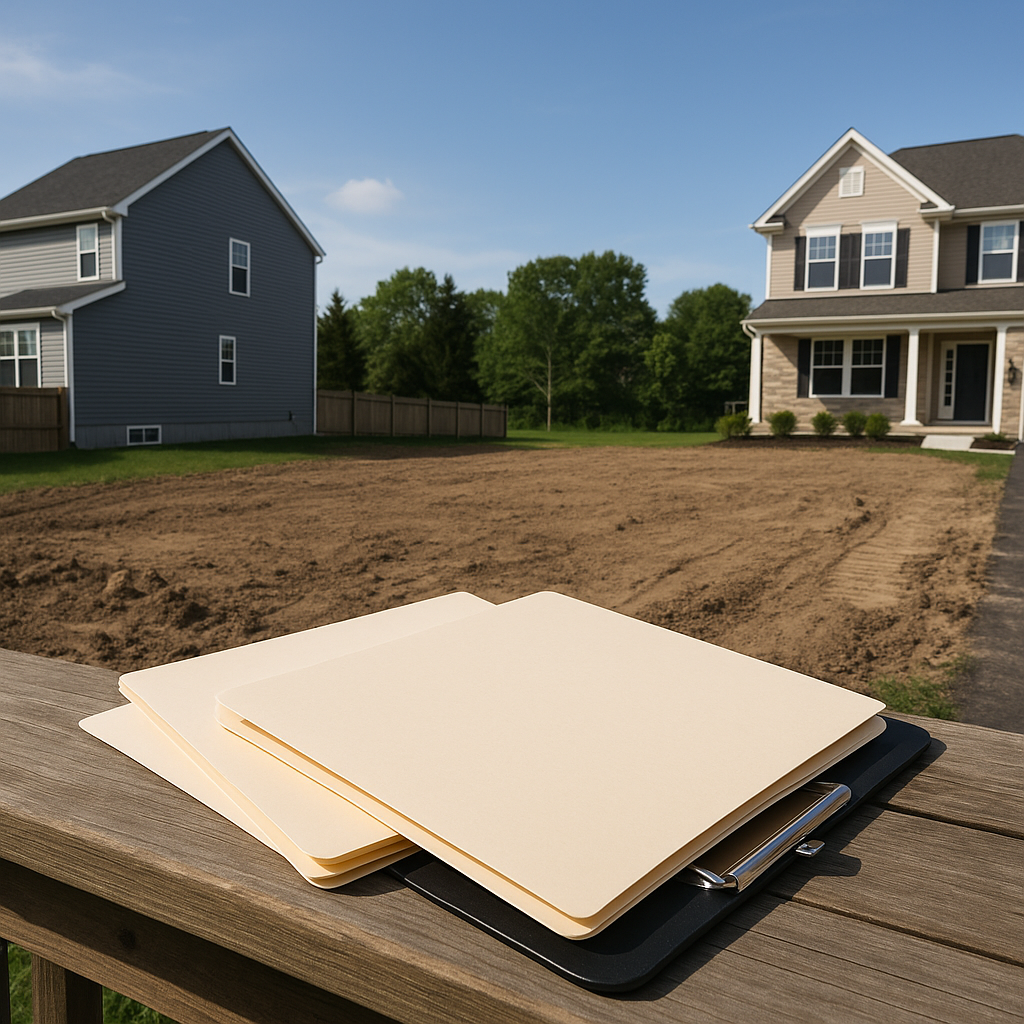
The Two-File Test for Burlington County Infill Lots for Builders
For builders looking at Burlington County infill lots, the first acquisition decision is not price. It is whether the parcel can survive two separate reviews: a record-identification file and a location-context file. If either file is thin, an attractive-looking off-market lot may be premature for a build pipeline.
Ultimate Land Deals publishes this screening framework for absentee owners and builders trying to have a more useful initial conversation about a residential lot. “Infill” can describe a buyer’s interest in a vacant parcel surrounded by existing development, but it is not, by itself, a conclusion about zoning, buildability, access, utilities, approvals, or lot yield. Those questions belong to the exact parcel and the responsible local authorities.
Case study: the lot that looked ready before anyone opened the file
This is an illustrative acquisition case, not a report about a specific property.
A builder receives an off-market lead for a small vacant lot in Burlington County. The lead says the property is “in a built-up area,” near homes, and appropriate for a single-family project. The owner lives out of state, has a tax bill, and wants a straightforward sale.
Those facts may justify a conversation. They do not yet justify a construction assumption.
The acquisitions lead creates two files before discussing a final price:
| File | Question it answers | What it should not be treated as proving |
|---|---|---|
| Record-identification file | Is this the right parcel, owner, and chain of recorded documents to investigate? | That the project is approved or buildable |
| Location-context file | Which municipality and planning context apply to this particular parcel? | That a location label establishes zoning, utilities, wetlands status, access, or permits |
The practical outcome is often one of three paths:
- Advance the lead when the parcel can be identified clearly and the remaining diligence questions fit the builder’s criteria.
- Request a narrower set of documents or confirmations when a key point is unresolved but potentially material.
- Pass or reprice when the unanswered questions do not fit the intended project or risk tolerance.
That discipline protects both sides. A builder avoids presenting a preliminary interest as a development conclusion, and an absentee owner avoids being asked to stand behind claims they cannot document.
File one: establish the parcel before evaluating the story
Start with the municipality, block, lot, and any qualifier shown in the owner’s available records. Use the owner’s deed, tax material, prior survey, correspondence, and other documents as leads—not as interchangeable proof of every property characteristic.
Burlington County’s Public Records Electronic Search System (PRESS) allows searches by municipality, block, and lot for property records recorded on or after March 1, 2012. It also allows name searches. The County states that records from 1965 through February 2012 can be searched only by property owner name, while records before 1965 are available through the County archive and are searchable only by owner name. PRESS also notes that maps recorded before 1995 are not available there. Burlington County PRESS
For the illustrative lot, that creates a simple checkpoint: can the builder and owner point to the same municipality, block, and lot across the available materials? If not, pause. A street description, a nearby subdivision name, or a marketing map should not substitute for reconciling the parcel identifier.
A useful first request to the owner is modest:
- the latest deed or recorded document they have;
- the tax bill or assessment notice they rely on to identify the lot;
- any survey, subdivision map, prior correspondence, or title material in their possession;
- the name in which the property is held; and
- any information they have about prior efforts to sell, build on, or improve the parcel.
The point is not to demand a complete development package from an absentee owner. It is to separate documents they possess from statements that still need investigation.
A record problem is not always a deal problem
An older recorded map missing from an online search result is not proof that no map exists. PRESS specifically says maps recorded prior to 1995 are not available on that system. Burlington County PRESS
The appropriate builder response is therefore not “the lot has no recorded map.” It is: Which record, office, title search, or document source should be consulted next to understand this parcel? That distinction prevents a search limitation from becoming a property conclusion.
File two: screen the municipal and Pinelands context without overclaiming
The second file starts with the exact municipality, not merely “Burlington County.” County-wide language can conceal materially different local questions.
The New Jersey Pinelands Commission lists 14 Burlington County municipalities among its Pinelands municipalities: Bass River Township, Evesham Township, Medford Lakes Borough, Medford Township, New Hanover Township, North Hanover Township, Pemberton Township, Shamong Township, Southampton Township, Springfield Township, Tabernacle Township, Washington Township, Woodland Township, and Wrightstown Borough. New Jersey Pinelands Commission: Pinelands Municipalities
That list is a routing prompt, not a parcel-level determination. A builder should not infer from a county name, a municipal name, or proximity to another parcel that a specific lot is subject to—or outside of—any particular Pinelands review or requirement. Instead, add a clear question to the acquisition file:
What location, planning, zoning, environmental, access, and service questions should be confirmed for this exact block and lot with the responsible municipal and other relevant authorities?
For an off-market lead, this question is more valuable than asking the owner to characterize the lot as “ready to build.” An owner may know the property history; they may not have current answers to development questions.
The builder’s one-page acquisition brief
Before issuing a serious offer, convert the two files into a one-page brief. It keeps the team from treating a sales narrative as due diligence.
| Brief item | Record it as | Decision use |
|---|---|---|
| Exact parcel identifier | Documented / needs reconciliation | Determines whether the team is evaluating the correct land |
| Owner and signing party | Documented / to be confirmed | Shapes title and contract follow-up |
| Municipal location | Documented | Routes local questions to the correct place |
| Pinelands-municipality flag | Yes / no based on the Commission list | Signals a context question, not a parcel ruling |
| Existing maps or surveys | Provided / not provided / older record to locate | Identifies what must be reviewed further |
| Proposed build concept | Builder assumption | Must not be presented as an approved use |
| Open diligence questions | Named, parcel-specific questions | Determines contingency, price, or pass decision |
A brief is especially useful where several people touch the deal: an acquisitions manager, a land planner, title contact, lender, and owner. It lets each party see what is documented, what is only reported, and what has not yet been answered.
What an owner can provide—and what a builder should verify
Absentee owners can make a Burlington County lot easier to evaluate by providing accurate identifiers and available records. They do not need to certify a builder’s project assumptions.
Appropriate owner-side statements:
- “This is the deed and tax material I have.”
- “This is the municipality, block, and lot shown on my documents.”
- “I do not have a survey,” or “I have attached the survey I received.”
- “I have not obtained a current answer to that development question.”
Builder-side verification questions:
- Does the intended use fit the builder’s acquisition criteria after parcel-specific review?
- What should be confirmed about the applicable local process for this exact parcel?
- Are the assumed access, service, lot configuration, and project characteristics documented or still open questions?
- Which party will investigate each open item, and can the purchase agreement reflect that allocation of risk?
This allocation is important in an off-market transaction. A direct acquisition can be efficient, but efficiency should come from clear information and clear contract terms—not from leaving material assumptions unstated.
Ultimate Land Deals describes an off-market model in which land can be sold directly to a specialist buyer and privately marketed to builders, developers, and land investors rather than placed on public listing channels. Its published Florida guide also describes evaluating a parcel and using different resale or acquisition paths. Off Market Land Deals for Developers in Florida Builders considering any counterparty should confirm the proposed buyer, due-diligence scope, assignment rights, deposit, closing steps, and other transaction terms in the written agreement.
When a direct buyer, broker, or owner-led sale fits the file
For an absentee owner, the strength of the two files can help determine how to sell.
- Direct buyer: Can fit an owner who prefers one counterparty and a simple discussion around the current file. The owner should compare the written price and conditions, not assume that “cash” resolves every contract question.
- Land-focused agent: Can fit an owner who wants broader market exposure and help presenting the parcel to multiple buyers. Ask how the agent will distinguish documented facts from development assumptions.
- Owner-led sale: Can fit an owner willing to coordinate inquiries and records themselves. It requires careful consistency: every prospective builder should receive the same parcel identifiers and source documents, with unknowns labeled as unknowns.
The best route depends on the owner’s desired level of involvement and the quality of the existing file. A thin file does not make a sale impossible; it means the seller should avoid pricing the land as if unresolved development questions have already been answered.
Resources
- Burlington County Public Records Electronic Search System
- New Jersey Pinelands Commission: Pinelands Municipalities
- Ultimate Land Deals
FAQs
Is a Burlington County parcel automatically a Pinelands parcel?
No conclusion should be drawn from the county name alone. The Pinelands Commission lists certain Burlington County municipalities as Pinelands municipalities, but parcel-specific location and applicable review questions should be confirmed for the exact property. New Jersey Pinelands Commission: Pinelands Municipalities
Can a builder search Burlington County records using block and lot?
PRESS states that property records recorded on or after March 1, 2012 can be searched by block and lot and/or owner name. The County gives different search guidance for older records. Burlington County PRESS
What should an absentee owner send first to a builder?
Start with the documents already available: the parcel identifiers, deed or other recorded material, tax material, and any survey or map. Label missing records and unanswered development questions plainly rather than guessing.
Does an “infill” description mean a builder can proceed?
No. It is a useful lead description, not a substitute for parcel-specific review of the builder’s intended project and the questions that apply to that exact block and lot.